See the Tabbed Pages for links to video tutorials, and a linked list of post titles grouped by topic.

This blog is expressly directed to readers who do not have strong training or backgrounds in science, with the intent of helping them grasp the underpinnings of this important issue. I'm going to present an ongoing series of posts that will develop various aspects of the science of global warming, its causes and possible methods for minimizing its advance and overcoming at least partially its detrimental effects.

Each post will begin with a capsule summary. It will then proceed with captioned sections to amplify and justify the statements and conclusions of the summary. I'll present images and tables where helpful to develop a point, since "a picture is worth a thousand words".

Showing posts with label Western Climate Initiative. Show all posts

Tuesday, February 15, 2011

The Regional Greenhouse Gas Initiative of the New England and Mid-Atlantic States

Summary:  The Regional Greenhouse Gas Initiative, including the six New England states and four Mid-Atlantic states, is the oldest greenhouse gas reduction regime in the U. S, using a cap-and-trade mechanism. Greenhouse gases are responsible for global warming occurring in recent decades.  It is also the most modest, affecting only emissions originating from electric power plants.  Since it began operating in 2009, it has collected large sums of money and has led to the creation of many new jobs and businesses.  While this modest beginning is praiseworthy, it is important to strive toward major, significant reductions in greenhouse gases, so that the increased level of greenhouse gases in the atmosphere can be stabilized.  

Introduction:  In recent years three regional initiatives have been set in place in the U. S. The Western Climate Initiative, formalized in February 2007; the Midwestern Greenhouse Gas Reduction Accord, set in place in November 2007; and the Regional Greenhouse Gas Initiative (RGGI), established in July 2007.  RGGI is discussed in this post.  The three regional accords encompass 23 states in the U. S. as well as several Canadian provinces.  Additional states and provinces are “observers” of the various accords.

The American states participating in these three agreements, and their greenhouse gas emissions, are shown in the following map:
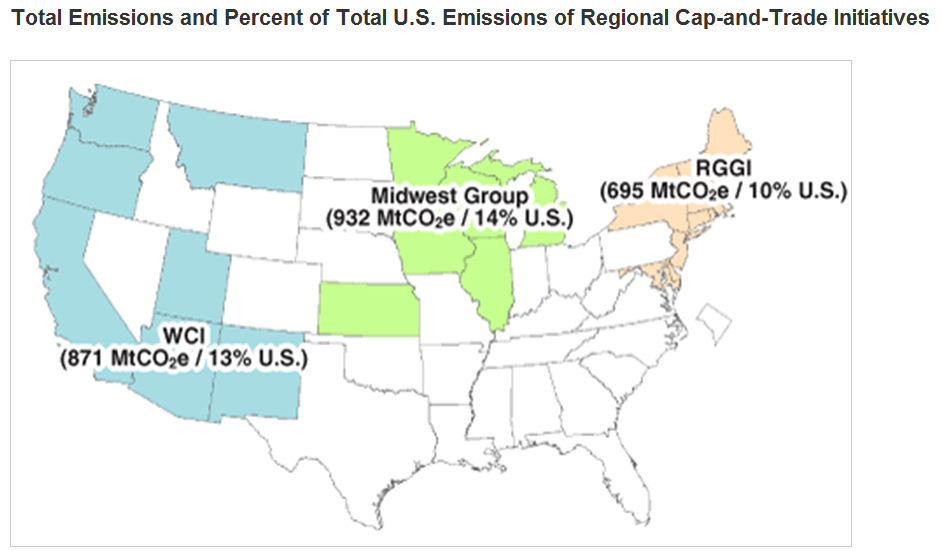


Map displaying the three regional greenhouse gas emission reduction programs in the U. S. (omitting Canadian provinces in WCI and the Midwest Group as well as their contributions to emissions).  WCI: Western Climate Initiative; Midwest Group: the Accord; RGGI: Regional Greenhouse Gas Initiative.  MtCO2e: Millions of metric tonnes of greenhouse gas emissions expressed in terms of carbon dioxide-equivalent greenhouse activity.  Percents are the portions of total U. S. emissions.  

RGGI incorporates the ten states of Maine, New Hampshire, Vermont, Rhode Island Massachusetts, Connecticut, New York, New Jersey, Delaware, and Maryland.  The notion of setting up this regime began with Gov. George Pataki of New York.  In 2003, he wrote the governors of 11 other states in the Northeast proposing to limit greenhouse gas emissions.  He recognized the success of cap-and-trade in combating the sulfur emissions from Midwest power plants that cause acid rain, and identified under the U. S. Clean Air Act.  

RGGI was formalized in July 2007 by the establishment of the nonprofit corporation RGGI, Inc., whose role is to coordinate and oversee the administration of the Initiative.  As with the other two accords, it is up to the individual states to enact the enabling laws for operation of the Initiative in the respective states.  A Memorandum of Understanding (MOU) among the member states was initially issued in December 2005 by seven of the ten states.  The remaining three joined by early 2007.  As such, RGGI is the first of the three regional greenhouse gas accords currently operating in the U. S.

The MOU recognizes that global warming due to man-made greenhouse gases is occurring, and that the resulting increase in average global temperature has negative effects on the states involved, including more severe droughts and floods, changes in forest composition, and increasingly damaging storm surges along the coast.  It also recognizes that reducing the need for imported fossil fuels will enhance energy security and will lead to development of new industries related to renewable and sustainable energy sources.

Contrary to the WCI and MGGRA which cover all major activities that produce greenhouse gases, the RGGI accord agreed on controls only for fossil fuels used in electric power generation, affecting facilities with greater than 25 megawatts (MW) generating capacity.  It covers 209 facilities across the region.  The member states agreed to create a CO2 Budget Trading Program within the region, with the goal of stabilizing and then reducing the overall emissions from this source.  Each state’s base emission amount was established at the outset, totaling 188 million tons of CO2, and is to remain fixed at that level from 2009 through 2014.  The emissions limits are implemented by selling emission allowances, where 1 allowance covers 1 ton of CO2 emissions.  Starting in 2015, the allowances for each state are to be reduced by 2.5% per year, so that by 2018 the emissions will be 10% below the starting level.  The Trading Program is in fact a cap-and-trade regime, in which the allowances are tradable in an auction market.  The auctions occur quarterly.  They ensure fair pricing of the right to emit greenhouse gases on an open market available to all parties.  RGGI estimates that the auction price increases the cost of electricity to the consumer by only 0.4% to 1%.

The MOU also allows for offsets that serve as substitutes for actual reductions of CO2 emissions from a particular source.  Instead of achieving reductions in emissions at an emitting site, the source may use a limited part of its CO2 allowances to purchase offsets from remote facilities that accomplish reductions of emissions or new increases in CO2 removal from activities such as afforestation.  Initially the offset facilities must be within the region covered by the Initiative, but can be expanded to be anywhere in North America.  Allowances granted are biased to favor using offsets within the region.

Each RGGI state uses two thirds of the proceeds from the sale of allowances to promote activities that contribute to further reduction in greenhouse gas emissions.  These include subsidizing energy conservation activities and promoting renewable energy industries.

The RGGI model presents itself as serving as an example for a) a functioning cap-and-trade regime, b) a program that will reduce greenhouse gas emissions from fossil fuels, and c) identifying and promoting new ventures developing renewable energy sources and conservation.   As the oldest regional accord in the U. S., RGGI should serve as an example for the other regional greenhouse gas reduction accords, as well as for any federal regime that may emerge directed toward reducing greenhouse gas emissions.

Political Environment and Practical Results.  RGGI is the first regional initiative in the U. S. set in place to combat greenhouse gas emissions that cause global warming; as noted, it uses a cap-and-trade system to achieve its objectives.  Political supporters of such programs point out that the revenues received from allowances should be considerable, and will support development of new businesses and creation of new jobs.  Enterprises involved in energy conservation, and the development and installation of renewable energy sources, benefit from investment of these public funds in their activities.  Opponents of such programs, and especially cap-and-trade regimes, point out that consumers wind up paying the extra costs to cover the expense of buying allowances.  This extra expense, they argue, inhibits job growth and enterprise creation, leading to exporting jobs elsewhere.

These considerations, and others, have led to the failure to impose greenhouse gas restrictions at the federal level in the U. S.  It is reported, however, that as of December 2010 RGGI has been a success in most of the states covered by RGGI.  Nine auctions have been held, garnering $729 million.  The auctions have proceeded without problems, contrary to the early experiences of the European Union’s Emission Trading Scheme.  In New York, for example, every dollar spent promoting renewable energy spawns six dollars of overall new economic activity.  RGGI states have created hundreds to thousands of new jobs from these funds.  This modest success in RGGI (based on power plant sources only) suggests that the two other, newer, greenhouse gas initiatives, WCI and MGGRA, should also have positive effects.

Unfortunately, positive revenue balances in government accounts are always susceptible to attack.  In the present economic environment in which most U. S. states have severe budgetary deficits, such reservoirs look very attractive.  It is reported that Gov. Chris Christie of New Jersey has diverted $65 million from RGGI revenues for general expenditures.  In Connecticut former Gov. Jodi Rell likewise diverted ratepayer funds for the energy Efficiency Fund; currently some may be restored (email from Clean Water Action). 

RGGI Leads the Way toward Stabilizing the World’s Atmospheric CO2 “Bathtub”.  The modest reductions in the emissions of greenhouse gases under RGGI are first steps toward achieving a leveling off of the atmospheric CO2 concentration.  Much more needs to be done, however. The global atmosphere, and its CO2 component, can be thought of as a "bathtub", having a "faucet" that adds new CO2, and a "drain" that removes CO2.  The present amount of CO2, about 390 parts per million (ppm), is already higher than in the past several thousand years, and the highest since the start of the industrial revolution.  The”faucet”, including increased burning of fossil fuels worldwide, is adding about 2 ppm CO2 each year; the “bathtub” is getting fuller.  (There are fewer balancing activities that “drain” CO2 and other greenhouse gases from the atmospheric “bathtub”.)  The stronger greenhouse effect from this CO2 leads to higher overall, long-term, global temperatures, which are also higher than in the past. 

Thus it is imperative not merely to reduce the rate of adding new greenhouse gases to the atmospheric “bathtub”, but rather to achieve zero world-wide emissions as soon as practically possible

References:

RGGI CO2 Allowance Tracking System http://www.rggi.org/docs/RGGI_COATS_in_Brief.pdf


© 2011 Henry Auer

Saturday, January 22, 2011

The Western Climate Initiative to Reduce Greenhouse Gas Emissions

Summary:  The previous post discussed California’s greenhouse gas (GHG) reduction program mandated under its Global Warming Solutions Act of 2006.  In this post we present a description of the Western Climate Initiative (WCI).  WCI is an agreement to reduce greenhouse gas emissions encompassing seven states and four Canadian provinces extending from British Columbia to Quebec.  Its principal goal is to produce economy-wide reductions in emissions by 15% from the levels of 2005 by 2020, using a market-based cap-and-trade mechanism.  Implementation of the program is to begin in 2012, and proceed in two phases. So far, however, only two of the seven states in the U. S. have progressed toward placing the program in effect.  Prospects for the Canadian provinces may be stronger.

Introduction.  The Western Climate Initiative is a transnational collaboration of California Arizona, New Mexico, Utah, Oregon, Washington, and Montana in the U. S., and British Columbia, Manitoba, Ontario and Quebec in Canada (called “entities” in this report).  Initially the governors of California, Oregon, Washington, Arizona and New Mexico established the Western Climate Action Initiative, in February 2007.  Their agreement recognized the detrimental effects of greenhouse gas-induced warming arising from human activities, such as prolonged droughts, excessive heat waves, reduced snow packs, altered precipitation patterns and more severe wild fires.  The initiative agreed that interstate collaboration was needed, and supported market-based policies to reduce GHG emissions as a cost-effective mechanism to so.

Goals of the WCI include reducing emissions of greenhouse gases that lead to global warming, developing alternative industries that provide new economic activities while also combating global warming, and minimizing the risks associated with adverse effects of global warming such as mentioned above. Importantly, it was undertaken in recognition of the failure of substantive action on climate change at the federal level. 

Greenhouse gases covered in WCI are carbon dioxide, CO2, as well as other gases.  The heat-trapping ability of CO2 on a molecule-for-molecule basis is relatively weak; its overwhelming importance is due to the massive amounts emitted by burning the large amounts of fossil fuels used in the world economy.  Methane or natural gas, when not burned as a fuel, escapes into the atmosphere from many sources; molecule-for-molecule methane is about 25 more potent in heat-trapping effectiveness than CO2.  Another gas arising from human activity, nitrous oxide (N2O), is even stronger, about 300 times more potent than CO2; other industrial gases, including sulfur hexafluoride (SF6) and a set of hydrofluorocarbons and perfluorocarbons, range as high as 23,000 times more potent than carbon dioxide molecule-for-molecule.  Thus small amounts of these gases in the atmosphere have effects that are many multiples of those of CO2.  Numerical conversions are made when reporting data for those gases into a unit called a CO2-equivalent.

The WCI Cap-and-Trade Program.  The WCI establishes a cap-and-trade program to reduce GHG emissions, with the goal of achieving reduction of 15% of the regional emission level evaluated for 2005 by 2020 (see schematic projection to 2020 in the following graphic). 


WCI GHG reduction goal for 2020 not including Manitoba, Ontario and Quebec, as of August 2007.  Source:  http://www.westernclimateinitiative.org/component/remository/func-startdown/91/

It is designed to reduce emissions produced by 90% of the economic activities of the member entities.  Since each entity is legally independent, each has to set its system up by its own laws and rules. 

Briefly, the program relies on emissions reporting, granting of “emission allowances” by each entity whose number establishes the cap, or upper limit of emissions.  Each allowance permits the owner to emit 1000 metric tons of CO2-equivalent GHGs in a year.   The allowances can be bought by or sold to (traded) to other entities in a WCI regional allowance market.  They are issued to each industrial and commercial source of GHG emissions.  The result of this market system is that it establishes a price for emitting GHG, which in essence creates a penalty for emitting.  This provides an incentive for each source to innovate in order to reduce emissions, thus reducing its costs each year.  Additionally, offsets of 5% of total emissions are allowed with external, qualified operations that draw GHGs from the atmosphere, anywhere in North America. Offsets include activities such as reforestation.

The complete formulation of the cap-and-trade system to be implemented by WCI  was released in August 2008.  It includes detailed economic modeling and reports earlier experience gained with GHG cap-and-trade regimes in California and the European Union. An updated summary of the Design Program was issued in August 2010.

Need for High-Quality Emissions Data From Rigorous Reporting.  The WCI Program relies on a rigorous, authoritative quantitative survey of GHG emissions from each entity for 2005 in order to establish its numerical emissions goal for 2020.   Ongoing surveys, and reports to the WCI administration, are to be submitted every year to ensure compliance and track progress.  In addition, these monitoring activities have to be created with an eye toward future regulatory regimes that U. S. federal and Canadian national governments, through the Environmental Protection Agency and Environment Canada, are likely to impose in the near future.

Setting Program Emissions Limits. The program proceeds in two phases.  The first, covering 2012-2014, envisions estimating emissions for 2012 that omit transportation fuels and low-volume emissions from residential and commercial fuels.  This interim limit is subjected to reductions in allowances until the second phase begins in 2015, when estimates for the omitted fuels are added in.  This total is then further reduced year-by-year to 2020.  This is shown in the following graphic.


Maintaining Competitiveness and Preventing Emissions Leakage.  In order to promote compliance with the program, WCI envisions promoting a high degree of competition to achieve cost-effective improvements in efficiency in a given economic activity or industry.  On the other hand, the program seeks to minimize “emissions leakage”.   Leakage is the avoidance of required reductions by shifting of apparent reductions in emissions to entities outside of the program that are not monitored by the program.  Those emissions would in fact increase, thus defeating the intent of the program.   One possible approach to preventing leakage is dispensing allowances without charge to those industries that are most subject to competition and that use large amounts of energy in their operations.   These operations are most likely to succumb to gaming the program.  WCI recognizes that this approach is also under consideration in the European Union, and has appeared in some U. S. congressional proposals.

Electricity Sector.  Electricity generation is uniquely distinguished by the interconnection of power plants with others outside the WCI by means of the electricity grid.  A provider of electricity in the program commonly purchases power from out-of-region generators.  The WCI program includes the emissions from such out-of-region generation in its survey of GHG emissions subject to its regulation.  In addition, voluntary development of renewable energy supplies is to be taken into account in surveys leading to granting of emission allowances.

Designing a Fair and Transparent Auction.  The WCI program envisions that an important way to distribute or reallocate emission allowances is by an auction.  Auctions will occur every three months using a single round of sealed bids in order to minimize counterproductive market manipulation of allowances.  A minimum auction price will be established which recognizes market factors at the time the auction takes place.  Auction trades will be posted for transparency and efficiency.  The market will be subject to upcoming rules that are being formulated both in the U. S. and Canada for the trading of commodities.  Kyle S. Smith, executive director for the Washington Wildlife Federation, has criticized the WCI allowance program because it has not made clear whether allowances will be free or must be purchased at the outset.  It is true that, at least for highly competitive industries, free allowances are indeed envisioned. (see above).  Security of allowances in the accounts is an important factor; news of the electronic theft of permits in the European Union in January 2011 has alerted the WCI and others to the need for protection against hacking.

Participation by Canadian Provinces.  The four provinces that have subscribed represent about 75% of Canada’s population.  As Ontario signed on to the WCI, Alberta and Saskatchewan decried the program at a meeting of provincial premiers in July 2008, calling the program a cash grab by Canada’s other provinces, which are less well off.  It has to be recognized that Alberta is the site of the massive crude oil production industry based on extraction from tar sands.  This mode of production requires far more fossil fuel input for extraction than does conventional oil production from wells drawing on deep geological reservoirs.  Alberta is responsible for the most GHG emissions of all the Canadian provinces.

Implementation in the U. S.  At the time of writing, only California and New Mexico, of the seven states participating in WCI, are on track to implement the accord.  In the November 2010 elections, California’s voters rejected a referendum initiative that would have ended implementation of California’s Global Warming Solutions Act (see the earlier post).  

New Mexico has issued rules to implement the program.  However, the new governor elected in November 2010, Republican Susana Martinez, is opposed to the program.  Earlier, in 2009, a committee of the state’s legislature failed to approve legislation to authorize carbon trading.  Furthermore, the state’s implementing rules may be challenged in court, and the new regulatory board to be appointed by Gov. Martinez may revoke the rules.  Oregon and Washington, even though generally pro-environment in outlook, have not developed rules for implementation, at least partly because of the difficult economic environment the U. S. is currently experiencing.

In February 2010 the Republican governor of Arizona, Jan Brewer, withdrew the state from the WCI.  This action is part of a statewide review of policies directed toward combating climate change.  Officials are concerned about the effect of the WCI on Arizona’s economic recovery.  The state legislature is strongly opposed to the cap-and-trade mechanism of the WCI, which requires legislation to place it in force.

Commentary on the program from Canadian bloggers appears more supportive of participation by Canada’s provinces than is the atmosphere in the U. S.   Some note the need for preserving, indeed strengthening, the limitations on GHG emissions in the WCI program.

Conclusion.  The California Global Warming Solutions Act of 2006 provides policies for reducing GHG emissions that fall within the WCI program.  As noted above, however, the political climate is an extremely difficult one for full implementation of the program elsewhere; so far in the U. S. only California and New Mexico have advanced toward its goals, while Arizona has dissociated itself from the initiative.  At the federal level in the U. S., strong opposition from the energy industry has influenced lawmakers, and the Congress has not passed legislation that limits GHG emissions.  As a result, an inefficient, variegated pattern of state and regional programs is coming into being. 

Passage of a single national energy policy directed to minimizing greenhouse gas emissions, leading hopefully to a stabilization of atmospheric greenhouse gas levels, would be far more preferable for economic and environmental policy on the national level, as well as on the international stage.  At the national level, a unified approach would help establish new industries and job opportunities, and relieve the U. S. from its critical dependence on foreign sources of fossil fuels. Ultimately, since this is a global problem, it requires a global approach.  Sound, concerted national policy by the U. S. and Canada would benefit all concerned interests.

© 2011 Henry Auer