See the Tabbed Pages for links to video tutorials, and a linked list of post titles grouped by topic.

This blog is expressly directed to readers who do not have strong training or backgrounds in science, with the intent of helping them grasp the underpinnings of this important issue. I'm going to present an ongoing series of posts that will develop various aspects of the science of global warming, its causes and possible methods for minimizing its advance and overcoming at least partially its detrimental effects.

Each post will begin with a capsule summary. It will then proceed with captioned sections to amplify and justify the statements and conclusions of the summary. I'll present images and tables where helpful to develop a point, since "a picture is worth a thousand words".

Showing posts with label climate change deniers. Show all posts

Thursday, April 30, 2015

Pope Francis’ Encyclical on Global Warming


[Updated May 7, 2015]

Encyclicals.  Pope Francis, the leader of the Roman Catholic Church, will soon issue a papal encyclical on global warming.  An encyclical is a document transmitted through the church hierarchy to its 5,000 bishops, and from them to all 400,000 parish priests.  In this way its contents are presented to the parishioners of every Catholic church throughout the world, about 1.2 billion people.
 
Encyclicals, wrote Pope Pius XII in Humani generis, can resolve discussion or controversy on a particular topic.  He declared    
“…if the Supreme Pontiffs in their acts, after due consideration, express an opinion on a hitherto controversial matter, it is clear to all that this matter… cannot any longer be considered a question of free discussion among theologians.” 

This statement indicates that an encyclical can resolve a controversy of doctrine by establishing the Church’s position from that time forward.

Climate Change, The Loss Of Biodiversity And Deforestation. Pope Francis has consistently been concerned with the less fortunate among the world’s people, including those adversely affected by climate change.  For example in October 2014, speaking to landless peasants and others, he stated

“An economic system centred on the god of money needs to plunder nature to sustain the frenetic rhythm of consumption that is inherent to it. The system [is based on] an economy … lacking in ethics…. Climate change, the loss of biodiversity and deforestation are already showing their devastating effects in the great cataclysms we witness.”

United Nations Climate Treaty.  According to Bishop Marcelo Sorondo, the Vatican’s Chancellor of the Pontifical Academy of Sciences, Pope Francis wants to exert a powerful influence on the convocation under the United Nations Framework Convention on Climate Change (UNFCCC) in Paris in December 2015, intended to finalize a worldwide climate treaty.  It is intended to rein in emissions of greenhouse gases and provide for assistance to impoverished nations to enhance sustainable energy production.  Bishop Sorondo stated

“Our academics supported the pope’s initiative to influence [upcoming] crucial decisions.  The idea is to convene a meeting with leaders of the main religions to make all people aware of the state of our climate and the tragedy of social exclusion.”

Elsewhere Bishop Sorondo ascribed global warming to humanity’s use of fossil fuels.

Nurturing Creation.  Pope Francis bases his concerns for the environment and global warming on the verses in Genesis dealing with creation.  In May 2014 he spoke in Rome, saying the “beauty of nature and the grandeur of the cosmos” are Christian virtues.  He urged his listeners to

“[s]afeguard Creation, [b]ecause if we destroy [it], Creation will destroy us! … Creation is not a property, which we can rule over at will; or, even less, is [it] the property of only a few: Creation is … a wonderful gift that God has given us, so that we care for it and we use it for the benefit of all, always with great respect and gratitude.”

With these words the Pope distinguishes our husbandry of creation from exploitation of nature, especially by a minority that has little regard for humanity as a whole.  In January 2015 he attributed global warming largely to manmade activities.

Vatican Symposium on Global Warming.  The Vatican convened a meeting of world leaders including the United Nations Secretary General Ban Ki-Moon, world religious leaders and leading climate scientists, on April 28, 2015.   Mr. Ban told the assembly “there is no divide whatsoever between religion and science on the issue of climate change.”

A report entitled “Climate Change and The Common Good”, prepared by clerical and lay scientists under the guidance of the Pontifical Academy of Sciences and the Pontifical Academy of Social Sciences was released at the same time as the symposium.  It summarizes the historical context of global warming, ascribing it to human activity “involving the unsustainable exploitation of fossil fuels and other forms of natural capital”. It summarizes the detrimental effects already visited on human society as a result, and reviews the scientific projections of future warming and its further harmful consequences to our planet and human society. 

The Role of the World’s Religions.  The report emphasizes how the religions of the world can be instrumental in combating continued global warming and its harms:

“The Catholic Church, working with the leadership of other religions, could take a decisive role in helping to solve this problem. The Church could accomplish this by mobilizing public opinion and public funds to meet the energy needs of the poorest 3 billion in a way that does not contribute to global warming but would allow them to prepare better for the challenges of unavoidable climate change….[W]e have a responsibility not only towards those who are living in poverty today, but also to generations yet unborn.”

This moral imperative is expanded as follows:

“Generations to come will experience and will likely suffer from the environmental consequences of the fossil fuel consumption of the last two centuries. They are likely to wonder what took 21st century citizens of the world so long to respond to these frightening climate trends….

In addition to the issue of inter-generational equity, climate change from fossil-fuel burning poses a major problem of intra-generational equity….We have to solve both [these] problems.”

Deniers of Global Warming.  This Vatican meeting so captured the attention of global warming deniers that they journeyed to Rome to counter the Vatican’s stand.   The President of the Heartland Institute wrote “The world’s poor will suffer horribly if reliable energy—the engine of prosperity and a better life—is made more expensive and less reliable by the decree of global planners.”  The American Petroleum Institute wrote “fossil fuels are a vital tool for lifting people out of poverty around the world, which is something we’re committed to.” 

By such statements we see that these apologists for maintaining the status quo cynically seek to shift guilt for the use of fossil fuels onto the heads of those, including the leaders of the world’s great religions, who themselves advocate for the rights of the poor.  These cynics suggest that energy reformers are guilty of prolonging suffering of the poor by removing their access to fossil fuel-derived energy. The deniers critically fail to admit that alternative sources of energy that do not contribute to global warming can accomplish the required objectives.

The Papal Encyclical itself is expected to be issued in June 2015.  It is likely to reflect the themes identified here that have already been expressed by the Church.  Subsequently Pope Francis will address the United Nations General Assembly and the U. S. Congress in September 2015.  His energetic activities with respect to global warming are focused on bringing his considerable influence, indeed that of all the world’s major religions, to bear on the climate meeting in Paris in December 2015.  That gathering, under the UNFCCC, is intended to finalize ongoing climate negotiations. It should provide  a worldwide agreement to reduce annual rates of emission of greenhouse gases, undertake measures to improve land use practices, and set up a major financing program to assist poor countries to adapt to the effects of global warming.

 Discussion

Pope Francis is undertaking an unprecedented, energetic campaign as the leader of the Roman Catholic Church to convince the nations of the world to commit to meaningful measures to attack global warming, and to help them adapt to the changing climate.   While some detractors may question whether the Church has a role to play in this largely secular, scientific matter, he has grounded his message in several aspects of Christian doctrine. 

First, the Scriptures emphasize the role of humanity to serve as stewards of Creation.  This includes first, avoiding exploitation of resources (such as fossil fuels) that rewards only a portion of humanity; second, avoiding exploitation of those resources because they are irreplaceable; and third, shunning activities in the energy economy that exclude the poorest among us from its benefits.  The Pope is concerned with our “intra-generational” responsibility for alleviating the disparities brought about by fossil fuel use. About 3 billion of the world’s people currently do not benefit from the advanced lifestyle that fossil fuel-derived energy provides to the rest of us.

And second, moral doctrines embedded in the Scriptures emphasize our inter-generational responsibility for the welfare of future generations: our children, their children, and further progeny whom we as yet do not know.  This concern arises from Pope Francis’s accurate understanding that the effects of global warming, ascribed to our present burning of fossil fuels, will persist for centuries and affect future generations.  In view of the changes already wrought, and the worsening of those changes as our use of fossil fuels grows, we are directly responsible, in his view, for the wellbeing of our progeny. 

When issued, the message of the encyclical will reach all 1.2 billion Catholics in the world.  According to the ecclesiastical significance of encyclicals proclaimed by Pope Pius XII, we expect that all Catholics will regard its conclusions as laying to rest any prior controversy surrounding this issue.  To the world’s Catholics the question of global warming will not “any longer be considered a question of free discussion among theologians.”

[Update: In a letter to the New York Times Maciej H. Grabowski, Poland’s environmental minister, writes that the Pope’s forthcoming encyclical will significantly influence the negotiations on a new global warming treaty that will take place at the end of this year.  He states “Pope Francis’s message will be greeted warmly in Poland.”]

In the United States, more than 160 representatives and senators in the Congress are Catholics.  This includes the Speaker of the House of Representatives.  Yet a significant portion of these congresspersons, including the Speaker, to date have not publicly accepted the reality of global warming caused by human actions.  To the extent that they consider themselves bound by their faith, we may expect that they will accept the forthcoming encyclical’s pronouncements as being beyond controversy.  A change of heart by these legislators could lead to progress toward a legislated national energy policy whose goal should be a decarbonized energy economy. 

Pope Francis envisions his encyclical and his promotion of sound energy policies as inspiring not only fellow Catholics around the world, but far more importantly as generating comparable actions in an ecumenical fashion among all the major faiths of the world.  He is reaching out to leaders of other religions with the intention of developing a faith-based consensus for action among followers of most religions.  This should lead to emboldened action by the world’s scientific and political leaders to reach early and meaningful agreement on a worldwide framework for the limitation of greenhouse gas emissions, appropriate changes in land use, and a well-funded resource to aid countries most in need of assistance in accommodating to climate change.

© 2015 Henry Auer

Friday, October 17, 2014

Deniers Mistakenly Say that Global Warming Has Ended


Global Average Temperatures and CO2.  The global average temperature has increased by about 0.7-0.8ºC (1.3-1.4ºF) over pre-industrial values.  Humanity’s use of fossil fuels to power industrialization emits carbon dioxide (CO2), a greenhouse gas, leading to warmer average temperatures.  Analysis of the increased CO2 levels shows that they arise directly from burning fossil fuels, and not from natural causes (see also the U. S. National Climate Assessment).

Climate deniers do not accept that our planet is warming, and/or that human activity is its cause.  Climate skeptics may question that human actions are responsible for warming, or that warming is harmful to human populations and other life forms.  Here both groups will be called “deniers”.

Climate deniers claim that global warming has ended.  They selectively display global temperature data for, say, the period 1980 to the present, as shown in this graphic:
 
 
Yearly values of the global average temperature selected for the interval 1980-2013, shown as their difference from the average temperature for the entire 20th century.
Source: Data table from National Aeronautics and Space Administration;
 
 
Other more biased presenters don’t show any data before 1997.  These deniers point to the interval after 1997 as showing that the temperature has remained essentially unchanged (here called the “pause”), breaking with the upward trend from 1980 to 1997.  Since atmospheric CO2 concentrations continued to increase during the pause period (see below), deniers state that increasing atmospheric concentrations of CO2 cannot be the cause for global warming.

 
Deniers  cannot selectively choose the data they wish to use while rejecting the entire data set from consideration.  It is unacceptable to focus arbitrarily on only the period supporting their view while ignoring the extended global temperature record.  Data covering most of the industrial era, 1880-present, are shown below. 
 

Yearly values of the global average temperature for 1880-2013, shown as the differences from the average temperature for the entire 20th century.  Black points and line, annual average temperature differences; Red line, smoothing obtained as a 5-year running window centered at each data point; Green, error bars showing estimates of uncertainty in the measurements.
Source: National Aeronautics and Space Administration.  http://data.giss.nasa.gov/gistemp/graphs_v3/
 
 
The overall trend shows a clear, if uneven, rise in the global average temperature beginning at about 1910, coinciding with increasing atmospheric levels of CO2 (see below and this post).  Importantly, a seemingly long pause also occurred from about 1950-1975, followed by more than 20 years in which the temperature rose sharply.  It is noteworthy that deniers fail to mention this earlier pause as evidence that warming has ceased.
 
A Simple Inert Earth Model.  Deniers are incorrectly assuming that in the Earth system, the only factor affecting the air temperature around the globe is the amount of CO2 in the atmosphere.  Such a simple model, featuring an inert Earth, may be illustrated using the following graphic.  

Model for a simplified inert Earth system close to radiation balance.  It re-emits much of the sun’s energy back into space as heat (infrared) radiation.  In this model only the atmosphere retains excess heat.  © Henry Auer

 
In essence, deniers ignore any additional components in the Earth system that affect the energy balance.

A Complex Earth System Model.  Why is the Earth’s temperature record so erratic?  Why do these pauses occur?  The answer to these questions is that the Earth is not a simple object inert to the effects of the sun’s energy.  Rather, the Earth is a complex system that responds to inputs of excess energy from the sun in many ways.  This can be modeled by a complex Earth system in the image below.
Model of the Earth system, including CO2 in its atmosphere and potential reservoirs of heat in the land, the oceans and the polar ice caps.  This Earth is not in energy equilibrium; less energy is radiated back into space than the energy falling on it from sunlight.  The extra energy heats the entire earth system, with most of the heat being stored in the ocean rather than in the atmosphere. © Henry Auer

 
This more realistic model for Earth is not in energy balance.  Direct satellite measurements of radiation leaving Earth are compared with sunlight energy reaching the Earth.  Because of the greenhouse effect the Earth retains excess heat, rather than re-emitting it back into space.  

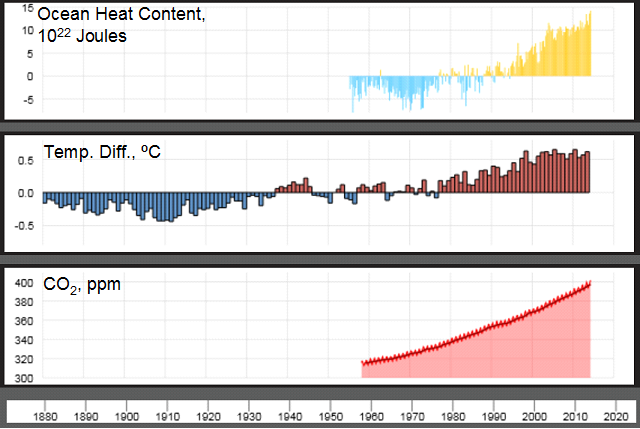
Most of the retained heat is stored in the oceans, and not in the atmosphere.  This is why deniers are mistaken by speaking in terms of an inert Earth model, i.e., in assuming that the temperature in the atmosphere is determined only by the atmospheric CO2 concentration.  This is shown in the following graphic.
 

Top panel: Total heat energy stored in the top half-mile of Earth’s oceans compared to the average from 1955-2006.  Middle panel: Yearly global average temperature compared to the average value for the full 20th century (repeating the pattern shown in the earlier graphic).  Bottom panel: Direct measurement of atmospheric CO2 from 1958 in parts per million (ppm).
Source: National Oceanic and Atmospheric Administration;
 
 
It is seen from the lower panel that the CO2 concentration has been rising steadily since 1958; indeed a smooth curve such as seen here extends back to pre-industrial times, when the concentration was 280 ppm.  The pronounced variability in the temperature data (middle panel) contrasts with the smooth, steady increasing trend seen  for CO2.  This suggests, as indicated above, that factors other than only the atmospheric CO2 concentration are at play. 
 
90% of the excess heat retained in the Earth system is stored in the oceans.  The data in the top panel show that heat energy absorbed by the oceans has been steadily increasing since at least about 1970, including the prior pause of global atmospheric temperature, and has continued to increase even during the current pause.  Instead of ending up warming the atmosphere, excess heat has been absorbed into the oceans, warming them (see the Details section at the end of this post).  Since oceans have decade-long cycles of vertical as well as lateral currents, this heat remains latent in the oceans, but will eventually be transferred back to the atmosphere, renewing the trend of increasing global atmospheric temperature.  
 
Conclusion
 
The long-term global average temperature has increased by about 0.7-0.8ºC over pre-industrial temperatures.  A current pause of annual global temperatures began after 1997 even though the atmospheric concentration of CO2 continued to increase during this period.  Global warming deniers have seized on this pause to say that warming of the Earth has ended, since the air temperature has not responded to the increased CO2 concentration on a year-by-year basis. 
 
In fact direct measurements of the Earth’s energy balance show that it does retain excess heat, but does not store it in the atmosphere.  Rather, the excess heat enters the oceans.  It is stored there as deep as 1,500 m (4,920 ft) in slow-moving ocean currents, both lateral and vertical.  As the warmer water is lifted to the surface again, it will exchange this stored heat with the atmosphere, resuming the warming of the air.  Similar processes happened in an earlier pause event.  Global (atmospheric) warming continues on the extended time scales dictated by Earth system processes.  Global warming deniers are mistaken in saying that global warming has ended.
 
Details
 
Guemas and coworkers (Nature Climate Change vol. 3, pp. 649–653 (2013); doi:10.1038/nclimate1863)  examined the current pause in global warming.  They used earlier data as a baseline to project sea surface temperatures forward up to 2010 using a coupled ocean-atmosphere climate model.  From their results they “attribute the onset of [the pause] to an increase in ocean heat uptake.”  They verify that no reduction in the sun’s radiation can explain the pause.
 
Loeb and coworkers (Nature Geoscience, vol. 5, pp. 110–113 (2012); doi:10.1038/ngeo1375) compared the energy imbalance of the Earth system with ocean heat content.  They measured radiated heat energy and sea temperatures.  They found that the energy imbalance of the Earth system and the increase in the upper-ocean heat content are similar in magnitude.  Combining satellite temperature measurements and ocean heat measurements to 1,800 m (5,900 ft) they found “between January 2001 and December 2010, Earth has been steadily accumulating energy at a [significant rate]. We conclude that energy storage is continuing to increase in the sub-surface ocean.”
 
Chen and Tung (Science Vol. 345, pp. 897-903 (2014)  DOI: 10.1126/science.1254937) analyzed earlier data as well as more extensive newer observations gathered by buoys disposed worldwide at various ocean depths.  They found that “the [pause] is mainly caused by heat transported to deeper layers in the Atlantic and the Southern oceans….Cooling periods associated with the latter deeper heat-sequestration mechanism historically lasted 20 to 35 years.”  They further conclude “because the planetary heat [reservoirs] in the Atlantic and the Southern Oceans remain intact, the [pause] should continue on a decadal time scale. When the internal variability that is responsible for the current [pause] switches sign, as it inevitably will, another episode of accelerated global warming should ensue.”
 
© 2014 Henry Auer