See the Tabbed Pages for links to video tutorials, and a linked list of post titles grouped by topic.

This blog is expressly directed to readers who do not have strong training or backgrounds in science, with the intent of helping them grasp the underpinnings of this important issue. I'm going to present an ongoing series of posts that will develop various aspects of the science of global warming, its causes and possible methods for minimizing its advance and overcoming at least partially its detrimental effects.

Each post will begin with a capsule summary. It will then proceed with captioned sections to amplify and justify the statements and conclusions of the summary. I'll present images and tables where helpful to develop a point, since "a picture is worth a thousand words".

Showing posts with label fossil fuel. Show all posts

Thursday, March 9, 2017

EPA Administrator Pruitt Wrongly Dismisses Reality of Man-Made Warming

Summary: The Administrator of the U. S. Environmental Protection Agency, Scott Pruitt, stated in a television interview that he does not agree that human activity is a prime contributor to global warming.
This statement is in direct contradiction to the well-established objective scientific reality that humanity’s burning of fossil fuels adds excess, long-lasting, burdens of carbon dioxide to the atmosphere.  Since this gas exhibits the greenhouse effect, this excess gas contributes to raising the global average temperature, and brings on harmful extremes of weather and climate.
Assessment Reports of the Intergovernmental Panel on Climate Change, and the U. S. National Climate Assessment, provide detailed support for such conclusions.  Climate scientists subscribe essentially unanimously to the reality of man-made global warming according to a search of the scientific literature.

Administrator Pruitt ignores these findings at great peril to the wellbeing of Americans, and indeed, of all humanity the world over.


The Administrator of the U. S. Environmental Protection Agency, Scott Pruitt, in an interview on CNBC on March 9, 2017 stated he did not agree that carbon dioxide contributes importantly to global warming.  Here is this writer’s transcript from CNBC’s video of the interview:
Interviewer: “Do you believe that it’s been proven that carbon dioxide is the primary control knob for climate?”
Pruitt: “No I think that measuring …precision human activity [sic] on the climate is something very challenging to do and there is tremendous disagreement about the degree of impact, so no I would not agree that it’s a primary contributor to the global warming that we see …. [W]e need to continue the debate…..” (Emphasis added.)
The world’s climate scientists have shown conclusively in peer-reviewed publications that Administrator Pruitt improperly rejects the reality of man-made warming. 
·        Carbon dioxide (CO2) is an important atmospheric greenhouse gas (a gas that traps heat leaving the surface of the earth and returns some of it to the surface.) 
 
·        CO2 is formed by burning fossil fuels; the excess CO2 released when humans use fossil fuels for energy has been accumulating in the atmosphere since the industrial revolution began.

·        Most CO2 we add to the air stays in the atmosphere for centuries or longer.  So the fuels burned in the nineteenth and twentieth centuries released CO2 that’s still in the air today.  This is why man-made CO2 is such a problem.
 
·        A particular property of CO2 (carbon isotope ratios) measured over time shows categorically and irrefutably that the increasing amount of CO2 in the atmosphere originates from humans’ use of fossil fuels, and not from any other possible source.

·        For the last 800,000 years atmospheric CO2 has never exceeded 280 volumes per million volumes of air (parts per million, ppm).  Humanity’s burning of fossil fuels has now pushed that above 400 ppm.  The rate by which we are adding new CO2 is many-fold faster than at any period in the last 800,000 years.

·        Because of the greenhouse activity of CO2 the earth’s temperature has been increasing, following the same long-term trend as the increase in CO2.

·        Climate models show that the recent increase in global average temperature is only accounted for when the increase in excess man-made CO2 is included in the models.  Using CO2 only from natural physical sources does not reproduce observed global temperatures.

·        Annual global average surface temperatures in 2014, 2015 and 2016, each in turn, reached record highs never seen in the historical record (beginning 1880).

·        Increasing numbers of extreme weather and climatic events have been directly attributed to worsening global warming, or their effects made worse from warming.

Contrary to Administrator Pruitt’s claim, there is no debate over the human cause of global warming.  The United Nations-sponsored Intergovernmental Panel on Climate Change (IPCC) Assessment Reports (ARs) and the U. S. Third National Climate Assessment (NCA) present the unambiguous conclusions of climate scientists worldwide that global warming is man-made.  In a survey of peer-reviewed journal articles on climate change, the authors are essentially completely unanimous in this conclusion.
The IPCC has issued five Assessment Reports (ARs) at 5 to 7 year intervals; the Fifth Assessment Report (5AR) was released in 2013-14 in three parts. Each part is prepared by hundreds of eminent climate scientists selected from among all member nations of the U. N.  
For example, for the first part of AR5, a first draft involved 659 experts and considered 21,400 comments by external reviewers; the second draft involved 800 experts different from the first group and 26 governments, and considered 31,422 comments. Only then was the final product released, approved by the scientists and by member governments. For this reason, 5AR meets every reasonable standard for scientific rigor, objectivity and validity.  It represents a worldwide consensus on the current status of climate science, including projections of future effects as the world continues to warm.  Its validity cannot legitimately be challenged.
The NCA was issued May 6, 2014 as mandated under the Global Change Research Act of 1990 to “assist the nation and the world to understand, assess, predict, and respond to human-induced and natural processes of global change”.
The NCA was prepared under the supervision of a federal advisory committee whose members are drawn from thirteen departments and agencies substantively involved in an aspect of global change science or policy.  It was drafted by over 300 scientists and experts drawn from academic research settings, federal agencies and research facilities, state agencies, nongovernmental organizations, private consulting organizations, corporations and foreign research organizations.  They critically reviewed original research articles published in peer-reviewed journals, and other reports of comparable scientific validity.  A draft of the Assessment was reviewed by others in federal agencies, the academic community, the public, and the National Academy of Sciences.  To issue the final Assessment 4,000 comments submitted by the reviewers were taken into consideration.  There can be no reasonable basis for doubting or dismissing the impartiality, cogency and veracity of the NCA’s findings.
Virtually Complete Unanimity of Acceptance of Man-Made Global Warming.  James Lawrence Powell recently published an article (Bulletin of Science, Technology & Society 1–4, 2016; DOI:10.1177/0270467616634958) which found that during 2013 and 2014 only 0.0058% of authors of peer-reviewed journal articles rejected the reality of man-made global warming.  Of the almost 70,000 authors of those articles only 4 reached that conclusion, giving a ratio of 1:17,352.  
Powell writes “[t]he extent of the consensus among scientists on [man-made] global warming [(MGW)] has the potential to influence public opinion and the attitude of political leaders and thus matters greatly to society.  [The results developed here show] the consensus on [MGW] among publishing scientists is above 99.99%, verging on unanimity.” (Emphasis added.)
Contrary to Administrator Pruitt’s claim, there is strong agreement on the degree of impact arising from global warming.  Both AR5 and NCA present extended discussions of the harms and damages arising from the impacts of global warming, and the prospects for more severe damages in the future as warming worsens.
Conclusion.  Administrator Scott Pruitt is wrong in “not agree[ing] that [human activity, burning fossil fuels is] a primary contributor to … global warming”.  The global community of climate scientists whose research is published in peer-reviewed journals agree essentially unanimously that man-made global warming is real.  The Administrator may continue to make such assertions, but they are not founded in objective scientific reality.  The consequences for federal policy of maintaining such views are alarmingly fraught.
© 2017 Henry Auer

Friday, October 31, 2014

The European Union Continues on Its Course to Lower GHG Emissions

The European Union confirms the next milestone along its energy Roadmap. The nations of the world are working toward establishing a new climate treaty by late 2015 that would lower future greenhouse gas emissions (among other provisions). Independently, the European Union (EU) agreed to a significant goal in reducing emissions of greenhouse gases (GHGs) on October 23, 2014.  The EU is a supranational organization of 28 member nations.  As detailed below, it has had policies in place for almost a decade to reduce GHG emissions.  The new pronouncement extends its timelines and codifies goals it had already established earlier.  Specifically, the EU agreed to lower GHG emissions by 40% below the emission levels of 1990 by 2030.  The goals also include achieving a 27% share of energy from renewable sources, and increasing energy efficiency by 27%.

Emission Trading Scheme. The EU began implementing policies to reduce GHG emissions as the Kyoto Protocol (KP) became effective.  Even before KP entered into force the EU created its Emission Trading Scheme (ETS) in 2005 in preparation for entering under its emissions restrictions.  The ETS is a cap-and-trade regime covering over 11,000 major fixed sources of GHG emissions, both governmental and corporate.  Unfortunately, for much of the time since then the ETS has failed effectively to set a market price for GHG emissions that would succeed to lower emissions.  Initially, too many allowances for emission were issued, so that their price tumbled.  As this was corrected, the Great Recession reduced economic activity, lowering demand for energy, again pressuring the price for allowances to fall.  As recently as 2013 the European Parliament temporarily suspended marketing new allowances.

The deliberations leading to the new declaration also had contentious issues .  Reducing emissions of carbon dioxide (CO2), the most prevalent GHG, affects coal-burning generating plants most severely because use of coal emits almost twice as much CO2 as does burning a fuel such as natural gas.  Countries in the EU heavily reliant on coal for electricity, such as Poland and other eastern European countries, were concerned that the excessive burdens of complying with the new constraints would hinder their economic growth.  The United Kingdom objected to goals for installing renewable power because of its new-found energy wealth in natural gas.  Germany has shut down its nuclear power plants after the Fukushima disaster, placing a greater burden on its existing coal-fired plants.

The new declaration keeps the EU within its overall timeline for long-term, major reductions in GHG emissions according to its energy Roadmap (see below).  But several environmental scientists and commentators consider the plan to be inadequate to achieve the stringent Roadmap objective in 2050.  They are concerned that the plan would leave too much of the intended reduction in emissions to be achieved later, in the two decades between 2030 and 2050, an achievement that may challenge the best technologies and policies available.  For example, Richard Black, the director of the British Energy and Climate Intelligence Unit, a nonprofit organization, doubted that this plan would “allow the E.U. to meet its long-term target of virtually eliminating carbon emissions.”

Background

The countries of the world currently face highly disparate energy situations and climate environments.  Their different conditions color their outlook as the world faces the problem of global warming brought on by humanity’s use of fossil fuels for energy.  In developed nations, which have benefited from the industrial revolution since its early days, citizens are comfortable with the lifestyle that abundant energy affords them.  Many are reluctant to change their ways to reduce emissions.  

Developing nations, on the other hand, have been applying energy-intensive technologies to expand their economies only in recent decades, desiring to catch up to the developed countries in relatively unconstrained fashion.  Their people too are reluctant to move away from fossil fuels to fulfill their growing energy needs. 

Impoverished countries and island nations experience the harms brought on by global warming for which they have not been responsible.  Their citizens hunger for the benefits that wider energy use could provide; those in island nations face encroaching seas as land-based ice sheets continue melting.

The United Nations Framework Convention on Climate Change (UNFCCC) has scheduled periodic global climate reports by the Intergovernmental Panel on Climate Change since 1990.  The UNFCCC led to negotiation of the Kyoto Protocol (KP) in 1997.  KP required developed countries to reduce greenhouse gas emissions, but excluded developing and impoverished countries from coverage.  KP entered into force in 2005 after the requisite number of countries ratified it (the U. S. never did, so it was not governed by its restrictions).  Most nations acceding to KP agreed to reduce emissions by varying amounts, generally less than 10%, below emission levels of 1990 by 2012. 
 
The  European Union issued a Roadmap for greenhouse gas emission reductions in 2011, intending to reduce annual emission rates by 80-95% below the level of 1990 by 2050 (see the following graphic). 

Source: “A Roadmap for moving to a competitive low carbon economy in 2050”,  broken down by economic sector. European Commission, March 8, 2011;
  
 
Interim milestones were established for reductions in emission rates of 7% by 2005, 20% by 2020, and 40-44% by 2030.  The European Environment Agency determined in 2013 that the EU is on track to achieve the 2020 milestone.  Renewable fuel use had climbed to 14% of total energy consumption.  About two-thirds of this originates from burning biomass and waste; in Sweden and Austria hydropower is also an important renewable source of electricity.  Wind and solar power contribute relatively small amounts to generation except for Denmark and Portugal (wind) and Cyprus and Spain (solar).
 
The EU is the most proactive region among developed countries in establishing policies to lower emission rates of GHGs.  The U. S., in contrast, has no legislated national energy policy directed toward mitigating GHG emissions.  In light of this failing executive actions of the Obama administration have imposed major limits on fossil fuel use in the transportation sector, have limited emissions from new electric power plants, and are proceeding similarly to lower emissions from power plants already in service.
 
Emissions from the developed countries of the world considered as a group have been relatively unchanged in recent years, and are projected to continue that trend (see the graphic below).


Annual rates of energy usage for China, the U. S. and India.  Actual use up to 2010; projected usage thereafter.  1 quadrillion = 1 million billion.  Btu, British thermal unit.
Source: U. S. Energy Information Administration; http://www.eia.gov/pressroom/presentations/sieminski_07252013.pdf (slide 5).

 
Energy use by developing countries will continue growing up to at least 2040, in contrast to the projected behavior of industrialized countries.  In the graphic above, expected energy use by China and India, which exemplify developing countries, expands dramatically in future years.  As noted earlier, energy use for the U. S., an example of a developed country, grows only very modestly to 2040.
 
Conclusion

The declared intention of the European Union to continue meeting its milestones under the energy Roadmap to 2050 is a major contribution to mitigating worldwide GHG emissions.  Similarly the executive actions taken by the U. S. have set it along a similar path, even if not enshrined in law.  These examples show “leadership by example” for the rest of the world as negotiations proceed toward a new worldwide climate treaty intended for completion at the end of 2015.  The continued expansion of fossil fuel use by major developing countries such as China and India, among others, stands in marked contrast to the examples of the EU and the U. S.  If left unaltered, policies of developing countries could potentially impede negotiation of a meaningful treaty.  Yet significant progress toward mitigation of GHG emissions must be made in order to keep the world’s long-term average temperature from increasing more than 2ºC (3.6ºF) higher than the prevailing temperature before industrialization.  This is the upper bound adopted at the Copenhagen (2009) and Cancun (2010) conferences of the UNFCCC.  The nations of the world must succeed in these negotiations.

© 2014 Henry Auer


Friday, October 17, 2014

Deniers Mistakenly Say that Global Warming Has Ended


Global Average Temperatures and CO2.  The global average temperature has increased by about 0.7-0.8ºC (1.3-1.4ºF) over pre-industrial values.  Humanity’s use of fossil fuels to power industrialization emits carbon dioxide (CO2), a greenhouse gas, leading to warmer average temperatures.  Analysis of the increased CO2 levels shows that they arise directly from burning fossil fuels, and not from natural causes (see also the U. S. National Climate Assessment).

Climate deniers do not accept that our planet is warming, and/or that human activity is its cause.  Climate skeptics may question that human actions are responsible for warming, or that warming is harmful to human populations and other life forms.  Here both groups will be called “deniers”.

Climate deniers claim that global warming has ended.  They selectively display global temperature data for, say, the period 1980 to the present, as shown in this graphic:
 
 
Yearly values of the global average temperature selected for the interval 1980-2013, shown as their difference from the average temperature for the entire 20th century.
Source: Data table from National Aeronautics and Space Administration;
 
 
Other more biased presenters don’t show any data before 1997.  These deniers point to the interval after 1997 as showing that the temperature has remained essentially unchanged (here called the “pause”), breaking with the upward trend from 1980 to 1997.  Since atmospheric CO2 concentrations continued to increase during the pause period (see below), deniers state that increasing atmospheric concentrations of CO2 cannot be the cause for global warming.

 
Deniers  cannot selectively choose the data they wish to use while rejecting the entire data set from consideration.  It is unacceptable to focus arbitrarily on only the period supporting their view while ignoring the extended global temperature record.  Data covering most of the industrial era, 1880-present, are shown below. 
 

Yearly values of the global average temperature for 1880-2013, shown as the differences from the average temperature for the entire 20th century.  Black points and line, annual average temperature differences; Red line, smoothing obtained as a 5-year running window centered at each data point; Green, error bars showing estimates of uncertainty in the measurements.
Source: National Aeronautics and Space Administration.  http://data.giss.nasa.gov/gistemp/graphs_v3/
 
 
The overall trend shows a clear, if uneven, rise in the global average temperature beginning at about 1910, coinciding with increasing atmospheric levels of CO2 (see below and this post).  Importantly, a seemingly long pause also occurred from about 1950-1975, followed by more than 20 years in which the temperature rose sharply.  It is noteworthy that deniers fail to mention this earlier pause as evidence that warming has ceased.
 
A Simple Inert Earth Model.  Deniers are incorrectly assuming that in the Earth system, the only factor affecting the air temperature around the globe is the amount of CO2 in the atmosphere.  Such a simple model, featuring an inert Earth, may be illustrated using the following graphic.  

Model for a simplified inert Earth system close to radiation balance.  It re-emits much of the sun’s energy back into space as heat (infrared) radiation.  In this model only the atmosphere retains excess heat.  © Henry Auer

 
In essence, deniers ignore any additional components in the Earth system that affect the energy balance.

A Complex Earth System Model.  Why is the Earth’s temperature record so erratic?  Why do these pauses occur?  The answer to these questions is that the Earth is not a simple object inert to the effects of the sun’s energy.  Rather, the Earth is a complex system that responds to inputs of excess energy from the sun in many ways.  This can be modeled by a complex Earth system in the image below.
Model of the Earth system, including CO2 in its atmosphere and potential reservoirs of heat in the land, the oceans and the polar ice caps.  This Earth is not in energy equilibrium; less energy is radiated back into space than the energy falling on it from sunlight.  The extra energy heats the entire earth system, with most of the heat being stored in the ocean rather than in the atmosphere. © Henry Auer

 
This more realistic model for Earth is not in energy balance.  Direct satellite measurements of radiation leaving Earth are compared with sunlight energy reaching the Earth.  Because of the greenhouse effect the Earth retains excess heat, rather than re-emitting it back into space.  

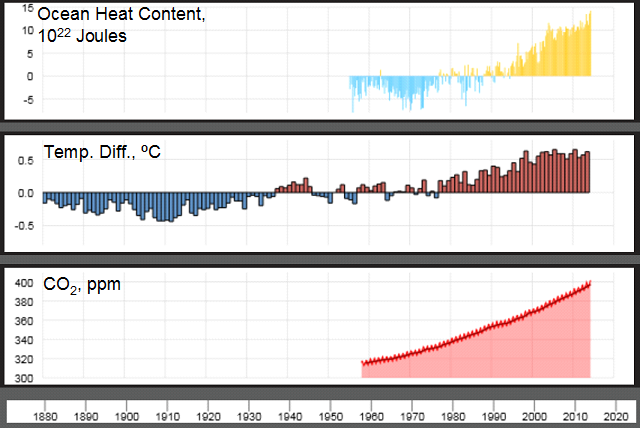
Most of the retained heat is stored in the oceans, and not in the atmosphere.  This is why deniers are mistaken by speaking in terms of an inert Earth model, i.e., in assuming that the temperature in the atmosphere is determined only by the atmospheric CO2 concentration.  This is shown in the following graphic.
 

Top panel: Total heat energy stored in the top half-mile of Earth’s oceans compared to the average from 1955-2006.  Middle panel: Yearly global average temperature compared to the average value for the full 20th century (repeating the pattern shown in the earlier graphic).  Bottom panel: Direct measurement of atmospheric CO2 from 1958 in parts per million (ppm).
Source: National Oceanic and Atmospheric Administration;
 
 
It is seen from the lower panel that the CO2 concentration has been rising steadily since 1958; indeed a smooth curve such as seen here extends back to pre-industrial times, when the concentration was 280 ppm.  The pronounced variability in the temperature data (middle panel) contrasts with the smooth, steady increasing trend seen  for CO2.  This suggests, as indicated above, that factors other than only the atmospheric CO2 concentration are at play. 
 
90% of the excess heat retained in the Earth system is stored in the oceans.  The data in the top panel show that heat energy absorbed by the oceans has been steadily increasing since at least about 1970, including the prior pause of global atmospheric temperature, and has continued to increase even during the current pause.  Instead of ending up warming the atmosphere, excess heat has been absorbed into the oceans, warming them (see the Details section at the end of this post).  Since oceans have decade-long cycles of vertical as well as lateral currents, this heat remains latent in the oceans, but will eventually be transferred back to the atmosphere, renewing the trend of increasing global atmospheric temperature.  
 
Conclusion
 
The long-term global average temperature has increased by about 0.7-0.8ºC over pre-industrial temperatures.  A current pause of annual global temperatures began after 1997 even though the atmospheric concentration of CO2 continued to increase during this period.  Global warming deniers have seized on this pause to say that warming of the Earth has ended, since the air temperature has not responded to the increased CO2 concentration on a year-by-year basis. 
 
In fact direct measurements of the Earth’s energy balance show that it does retain excess heat, but does not store it in the atmosphere.  Rather, the excess heat enters the oceans.  It is stored there as deep as 1,500 m (4,920 ft) in slow-moving ocean currents, both lateral and vertical.  As the warmer water is lifted to the surface again, it will exchange this stored heat with the atmosphere, resuming the warming of the air.  Similar processes happened in an earlier pause event.  Global (atmospheric) warming continues on the extended time scales dictated by Earth system processes.  Global warming deniers are mistaken in saying that global warming has ended.
 
Details
 
Guemas and coworkers (Nature Climate Change vol. 3, pp. 649–653 (2013); doi:10.1038/nclimate1863)  examined the current pause in global warming.  They used earlier data as a baseline to project sea surface temperatures forward up to 2010 using a coupled ocean-atmosphere climate model.  From their results they “attribute the onset of [the pause] to an increase in ocean heat uptake.”  They verify that no reduction in the sun’s radiation can explain the pause.
 
Loeb and coworkers (Nature Geoscience, vol. 5, pp. 110–113 (2012); doi:10.1038/ngeo1375) compared the energy imbalance of the Earth system with ocean heat content.  They measured radiated heat energy and sea temperatures.  They found that the energy imbalance of the Earth system and the increase in the upper-ocean heat content are similar in magnitude.  Combining satellite temperature measurements and ocean heat measurements to 1,800 m (5,900 ft) they found “between January 2001 and December 2010, Earth has been steadily accumulating energy at a [significant rate]. We conclude that energy storage is continuing to increase in the sub-surface ocean.”
 
Chen and Tung (Science Vol. 345, pp. 897-903 (2014)  DOI: 10.1126/science.1254937) analyzed earlier data as well as more extensive newer observations gathered by buoys disposed worldwide at various ocean depths.  They found that “the [pause] is mainly caused by heat transported to deeper layers in the Atlantic and the Southern oceans….Cooling periods associated with the latter deeper heat-sequestration mechanism historically lasted 20 to 35 years.”  They further conclude “because the planetary heat [reservoirs] in the Atlantic and the Southern Oceans remain intact, the [pause] should continue on a decadal time scale. When the internal variability that is responsible for the current [pause] switches sign, as it inevitably will, another episode of accelerated global warming should ensue.”
 
© 2014 Henry Auer


Wednesday, January 29, 2014

Our Children Look Us in the Eye: President Obama’s State of the Union Speech

Summary.  President Obama delivered his annual State of the Union speech on January 28, 2014.  A portion dealt with energy policy and global warming.  He laid down a fundamental guideline for the U. S. and the world to address climate change, one whose motivation is the moral imperative to leave a world for our children’s children that is powered by renewable energy rather than by fossil fuels.

The President’s administration has put in place several policies that promote reductions in the rates of emission of CO2.  Nevertheless, his “all of the above” energy policy emphasizes expanding the domestic production of fossil fuel, permitting the nation to approach energy independence.  The policies and the infrastructure underlying “all of the above” ensure that fossil fuels will be extracted, and CO2 will continue to be released, for decades to come, defeating the President’s moral imperative.

Only by migrating away from fossil fuels and toward renewable energy sources as soon as practicable (given the long delay times involved in transforming the necessary infrastructure) can we ensure the energy security of our children’s children.                                
 

President Obama’s State of the Union speech  on January 28, 2014, delivered to a joint session of Congress, included an important section on energy policy and global warming.  He stated what is probably the most profound and basic motivation for attacking the problem of global warming: 

“Climate change is a fact.  And when our children’s children look us in the eye and ask if we did all we could to leave them a safer, more stable world, with new sources of energy, I want us to be able to say yes, we did.” 

This statement illumnates the core of our attitudes and behavior about global warming, namely, the strong desire we all feel to pass on to our children and further progeny a secure world not threatened by the consequences of our present environmental actions.  Unfortunately the President’s remarks omit the important aspect of attribution: humanity’s use of fossil fuels is a major contributor to global warming.  This is explained in the following Details.

          Details

1.     Climate scientists have shown that it is possible to assess the level of atmospheric carbon dioxide (CO2), a principal greenhouse gas, as well as the ambient temperature by sophisticated analysis of geological samples; the assay for temperature is termed a “proxy”.  Over the last 800,000 years the data show that atmospheric CO2 and the temperature proxy fluctuate in cycles lasting thousands of years, and that their fluctuations over time are highly correlated with each other.  Over this interval the atmospheric CO2 concentration was almost never higher than 280 parts per million (ppm; volume of CO2 gas present in 1,000,000 volumes of air assayed).

2.     Just prior to the start of the industrial revolution, the CO2 concentration was 280 ppm.  The industrial revolution has been powered by human’s burning of fossil fuels (coal, oil and natural gas) to provide the energy needed for industrialization.  This releases additional CO2 into the air, increasing the atmosphere’s retention of solar energy as heat, warming the earth’s atmosphere.  Over the last 250 years all three data sets, humankind’s burning of fossil fuels, the atmospheric concentration of CO2, and the long-term globalaverage temperature, have all increased following timeline trends that are virtually identical to each other, i.e., they are closely correlated.  This raises the likelihood that there is a causative relationship among them.  The changes observed are occurring 50-100 times more rapidly than the natural geological changes described in the first paragraph.

3.     A further physical proxy can determine whether CO2 originated from mineral sources (e.g. release of CO2 dissolved in the water of the oceans) or from fossil fuels.  The time course of this fourth data set over the same time period follows the same course as do those for fossil fuel use, the increase in CO2, and the global temperature.  This shows unequivocally that the additional CO2 in the atmosphere appearing during the industrial era originates from our burning of fossil fuels, and not from some other natural process not involving humankind’s actions.  It also makes highly likely that the increase in global temperature is due to the increased CO2 in the atmosphere.

4.     Climate models have been used retrogressively to seek to reproduce existing temperature data from about 1915 to the present.  If the models omit the added CO2 from fossil fuels the predicted temperature remains low, not rising after 1950.  Only by including this additional CO2 do the models successfully reproduce the observed higher temperatures in the record.  This shows unequivocally that the additional CO2, which arises from fossil fuels, causes the increase in long-term global average temperature.
 
Projections of future greenhouse gas emissions predict that most developed countries of the world, including the U. S., will not increase annual emission rates significantly, whereas major emitters among the developing countries, especially China and India, will continue to do so at drastic rates.  This has been termed “business as usual”, and is projected to lead to large increases in atmospheric CO2, higher average temperatures, and more frequent and severe extreme weather and climate events.  The President pointed out “we have to act with more urgency because a changing climate is already harming western [American] communities struggling with drought and coastal cities dealing with floods.”  It must be emphasized, however, that policies at the worldwide level, not simply within the U. S., are needed to interrupt this trend and keep harmful consequences to a minimum.

President Obama reiterated his “all of the above” energy policy, which promotes current expansion of fossil fuel resources within the U. S. while at the same time implementing policies that reduce their use in the future.  He praised the “all of the above” strategy, noting that “today America is closer to energy independence than we have been in decades.”   He cited the migration to increased use of natural gas as a major factor in this trend, calling this fuel “the bridge fuel that can power our economy with less of the carbon pollution that causes climate change.”  He encouraged Congress to promote this trend by providing for natural gas fueling stations to help “shift more cars and trucks from foreign oil to American natural gas”.  At the same time, he noted, the U. S. is expanding its use of solar power, a renewable energy source.  He recognized the barriers facing expansion of renewable energy, urging “a smarter tax policy that stops giving $4 billion a year to fossil fuel industries that don’t need it so we can invest more in fuels of the future that do.”

The President reviewed the executive actions of his administration that will reduce fossil fuel consumption going forward.

“[E]ven as we’ve increased energy production, we’ve partnered with businesses, builders and local communities to reduce the energy we consume. When we rescued our automakers, for example, we worked with them to set higher fuel efficiency standards for our cars. In the coming months I’ll build on that success by setting new standards for our trucks so we can keep driving down oil imports and what we pay at the pump.”
 
Analysis
 
Moral basis for climate action.  President Obama laid down a forceful imperative, that of working to abate global warming for the welfare of our children and their children, and by inference, our future progeny whom we will never know.  We can consider this the most powerful, fundamental driver for action against global warming.  It is a principal motivation for the faithful, who consider that they have been appointed to be stewards of God’s creation.  It is an important guiding principle for others as well who direct their actions to the improvement of the world and the lives of their fellow humans.  On the national level here in the U. S., establishment of the national park system clearly is consistent with these principles, for it set aside federal lands in perpetuity for the benefit of our fellow citizens.

President Obama’s administrative actions have promoted mitigation of global warming.  The President has been faced with Congressional opposition to combating global warming, continuing a long history of Congressional recalcitrance.  Faced with this situation he has acted in several ways to reduce fossil fuel use.  He has set in place automotive fuel efficiency standards that halve fuel use by 2025.  His administration has just issued emission standards for new large electricity generating plants, and will follow up with standards for existing plants.  These will have the effect of eliminating use of coal-fired plants unless they install expensive capturing technology, since burning coal emits almost twice as much CO2 per unit of electricity generated as does natural gas.  In addition, the President issued a comprehensive Climate Action Plan setting forth a broad range of policies.

President Obama’s “all of the above” energy policy needlessly prolongs CO2 emissions from burning fossil fuels.  President Obama’s administration controls permits to develop fossil fuel extraction on federal lands and offshore, but not on private land.  Conventional wells have long production lifetimes, so that once in operation, there is a legacy period of production that ensures emission of CO2 from the extracted fuels for the lifetime of the well, one to a few decades.  Installations for hydraulic fracturing to yield gas and oil have shorter service lifetimes.  To the extent that extraction on public lands is being promoted, “all of the above” ensures continued new emissions of CO2 for one to a few decades. 

CO2 and other GHGs persist in the atmosphere for a century or more once emitted; they are not cleansed by any natural process.  Ever since humans began burning fossil fuels in the industrial revolution, the level of CO2 in the atmosphere has been higher than at any time in the last 800,000 years.  The rate of accumulation of additional CO2 is now about 50-100 times faster than has occurred in the geological past from natural processes.   For all these reasons, the longer the nations of the world, including the U. S., delay combating global warming, the more difficult it will be to achieve results later.

For this reason, President Obama’s “all of the above” policy is counterproductive, promoting expanded domestic production of fossil fuels.  Production of natural gas is expanding rapidly, and new drilling for offshore oil is being allowed to proceed.  Oil and gas pipelines are growing and a major pipeline, the XL project for importing Canadian oil originating from tar sands, is being weighed for approval. 

Minimizing increased global warming.  Every energy policy should be evaluated  according to whether it abates emissions or contributes more.  We may slow the rate of accumulating more GHGs in the atmosphere, but we are powerless at present to reduce the amount already accumulated.  “All of the above” continues to add greenhouse gases.  Our energy economy should have only one objective, namely, to reduce the additional accumulation of GHGs as rapidly as possible.  Only in this way can we limit the long-term average global temperature to as small an increase as possible.  Only in this way, “when our children’s children look us in the eye and ask if we did all we could to leave them a safer, more stable world, with new sources of energy, [can we] say yes, we did.”
 
© 2014 Henry Auer