See the Tabbed Pages for links to video tutorials, and a linked list of post titles grouped by topic.

This blog is expressly directed to readers who do not have strong training or backgrounds in science, with the intent of helping them grasp the underpinnings of this important issue. I'm going to present an ongoing series of posts that will develop various aspects of the science of global warming, its causes and possible methods for minimizing its advance and overcoming at least partially its detrimental effects.

Each post will begin with a capsule summary. It will then proceed with captioned sections to amplify and justify the statements and conclusions of the summary. I'll present images and tables where helpful to develop a point, since "a picture is worth a thousand words".

Showing posts with label energy economy. Show all posts

Thursday, July 28, 2016

Rediscovering the Will to Change: A New Energy Economy

Summary.  The growth of the U.S. from an agricultural society to an industrial power was driven in important ways by ambition, a positive attitude, and an ability to see opportunities and develop them.  Examples of changes that contributed to this growth include new means of transportation and communication.

As our economy grew and matured, however, unforeseen harmful effects of some activities became apparent.  Acid rain from electric generation was identified as the cause of dying forests.  Synthetic refrigerants were flagged as the cause of the depletion of ozone in the stratosphere.  Increased carbon dioxide from burning fossil fuels for energy was marked as the cause of global warming and its harms. The industries in question ignored the science behind these findings, and fought the need to change their business activities.

Global warming remains an unresolved problem.  Because of the vast size of the fossil fuel industry and the major changes already brought about by global warming it needs to abandon its resistance to change.  Its business model of providing energy for a growing and developing world remains, but needs to switch to carbon-free sources and to develop new technologies.  This new model will still yield profits for the industry, and continue to provide jobs for the economy.
 

American growth.  Throughout much of our history America has been a country marked by people bent on succeeding.  An entrepreneurial spirit drove the development and widespread adoption of new devices and new technologies that dramatically advanced our economic growth and improved living conditions for our population.

Railroads.  For millenia news and articles of commerce could travel no faster than men, or their animals, could carry htem.  The advent of the industrial revolution in the early nineteenth century, however, brought coal-powered transportation; railroads crossed the landscape faster and further than had been possible earlier.  This dramatically accelerated commerce and the exchange of technologies among populations separated by large distances, improving the lives of the participants.   Coal was also the fuel used in the growing iron and steel industry that permitted forging the rails, building the bridges, and providing the skeletons for new skyscrapers rising in cities.  The force behind all this growth was the vision of the industrialists and architects who created these enterprises and buildings.

Automobiles.  Human ambitions also led to the development of the gasoline engine and its use to power individual transportation, the automobile.  This depended on newly discovered sources of liquid fuels, the petroleum deposits in
Pennsylvania, Oklahoma, and elsewhere.  Liquid fuels provided vastly improved convenience and independence to the consuming public, as well as to the military.  The foresight and ambition driving this change is another example of the positive attitudes of the entrepreneurs behind this growth. 

This spirit gave rise to
America's exceptional industrial expansion, helped it survive the Great Depression of the 1930's, and was the spirit invoked by President Roosevelt and our military leaders to fight the war that ultimately defeated the Axis powers. 

Electronics.  A final example is drawn from the electronics industry.  Over the course of the 20th century electronics moved completely from analog to digital circuitry based on solid state transistors.  This transformation likewise was driven by forward-looking scientists and entrepreneurs.  Its growth was highly dependent on creativity and resilience, since the pace of technological advance, and therefore the competition in the industry, was very intensive.

Optimism.  These examples are cited to emphasize the "can-do" enthusiasm that has marked the growth of
America over its history.   Much of our expansion was further promoted by favorable state and congressional action.  The Homestead Act drew Americans with a vision to move west and spread roots in a new setting.  Railroad expansion likewise was fostered by supportive laws.  Recovery from the Great Depression and fighting the Second World War depended crucially on the cooperation between the president and Congress.

Resisting change: Acid rain.  In more recent decades, however, interest groups have opposed the need, based on scientific findings, for changes in their operations.  In the 1970s forests in the American northeast and southern
Canada began dying mysteriously.  Lakes and rivers had massive fish die-offs.  Scientists eventually traced the cause to the presence of sulfur dioxide and nitrogen oxides, strong acids when they combine with moisture, in the exhaust gas from coal-burning power plants.  The plumes from these plants became windborne and carried the acids many hundreds of miles from their sources.  The acidic moisture fell to the ground whenever it rained.  The acidity became so severe that forests could no longer tolerate it and died in vast swaths.  The same phenomenon occurred in Europe.

The solution to this malady lay in desulfurizing the exhaust gases of the offending power plants or fuel switching to low sulfur fuels.  The U. S. Environmental Protection Agency (EPA) imposed limits on how much sulfur dioxide and nitrogen oxides could be emitted by the power plants.  The power companies objected vigorously to what they protested would be the great expense required to implement this remedy. 

As of 2014 EPA projected that acid emissions would fall between 54 and more than 70% from 2005 levels, with estimated health savings of $120 to $280 billion per year . The measures have been effective, as the acid rain problem has diminished significantly in recent years.
 
Depletion in the ozone content of the upper atmosphere.  Ozone, a molecule consisting of three oxygen atoms, forms by the action of sunlight on the more common oxygen molecule, consisting of two oxygen atoms.  Depletion of ozone over Antarctica was first detected in the 1980's, and grew worse each year during that region's summer.  Ozone is important because it screens out the sun's ultraviolet (UV) rays, whereas the oxygen molecule does not.  Penetration of UV increases the occurrence of skin cancer and promotes cataracts in the eye lens.

Atmospheric scientists Mario Molina, F. Sherwood Rowland and Paul Crutzen showed that man-made chlorofluorocarbons (CFCs), used in aerosol spray cans, air conditioners and refrigerators, can cause the loss of ozone when combined with the action of sunlight.  (They were awarded the Nobel Prize for this work in 1995.)  The scientists strongly recommended phasing out use of CFCs for refrigeration. 

Companies in the U. S. that made CFC's, such as DuPont and Pennwalt; chemical manufacturers in Europe; and makers of aerosol spray cans mounted intense public relations campaigns questioning the science connecting CFCs with ozone loss.  They warned of massive economic loss if they were required to halt production.  Major constraints on CFC use came with the Montreal Protocol, an agreement under the United Nations (U. N.) in 1987, which U. S. President Ronald Reagan agreed to.  It called for phasing out the use of CFCs.  By 2016, Susan Solomon (who had helped identify the problem at the time of Montreal Protocol) and coworkers reported the ozone extent over Antarctica is starting to increase, decades after the Protocol was agreed to.  They were able to link the increase to lower levels of ozone-depleting chemicals in the stratosphere.

Global warming. Ever since the beginning of the industrial revolution, economic progress and enhanced living standards have relied on the ready availability of energy sources, primarily fossil fuels.  Worldwide consumption of energy continues to increase, driven especially by policies promoting economic growth in the developing world.  As of 2010, providing energy to the world’s population accounted for about 8% of global economic activity, of which about US$4.4 trillion was for the fossil fuel share.  Yet scientists as long ago as the nineteenth century recognized that carbon dioxide (CO2), the combustion product obtained when fossil fuels are burned, is a greenhouse gas leading to global warming. 

In recent decades scientists from around the world have warned that the growing accumulation of CO2 in the atmosphere from human fuel use would have serious harmful effects on the earth’s living systems.  They have pointed out in a succession of reports, beginning in 1990, that the sooner we agree to limit fossil fuel use, the easier and more effective the abatement measures would be. 

In the United States, the economic power of the fossil fuel industry and the political power of naysayers have been directed against the predictions of harm from the scientific community.  Dr. James Hansen, a renowned climate scientist, had been warning of the effects of global warming for many years.  His concerns were suppressed by the administration of President George W. Bush, made possible since Hansen, employed by the National Aeronautics and Space Administration, was a government employee (James Hansen, “Storms of my Grandchildren”, Bloomsbury, 2009).  Fossil fuel interests have mounted an ongoing campaign to plant seeds of doubt among the public concerning man-made global warming (Naomi Oreskes and Erik. M. Conway, “Merchants of Doubt”, Bloomsbury Press, 2010).  U. S. Senator James Inhofe has published the book “The Greatest Hoax: How the Global Warming Controversy Threatens Your Future” (WND Books, 2012).  Scientists at Exxon Mobil in the 1970’s and 1980’s published research addressing the global warming issue.  At the time they recognized “Exxon's … ethical credo on honesty and integrity."  Yet by the late 1990’s, when the U. N.-sponsored Kyoto Protocol to limit further warming was being negotiated, the company reversed its policy and sought to raise doubts about the scientific basis of man-made global warming.

Discussion
 
The growth of the United States, and its westward expansion, in the nineteenth and early twentieth centuries is a reflection of the optimistic, “can-do” spirit that pervaded the country in those periods.  Much of this growth depended on exploitation of new scientific, engineering and technological advances by enterprises in both the private and public realms.   

In more recent times as technology has expanded, however, unforeseen harmful effects of byproducts from the use of these technologies have become apparent.  The cases described above are examples of how commercial and political interests coalesced to refuse to accept scientific realities and to reject the remedies required.  Acid rain arose from the trace levels of sulfur present in coal and oil, while the heat of combustion converted the nitrogen of the air into acidic nitrogen oxides.  Depletion of stratospheric ozone is due to the diffusion to the stratosphere of trace amounts of man-made refrigerants.  The industries in question, electric power generation and chemical manufacturers, opposed implementing the changes needed to address the problems even in the face of compelling scientific evidence.  In the end the technological fixes for these two effects were not excessive, and remedies were put in place.

Refusal to accept the scientific validity of man-made global warming is the most profound example of the “won’t change” mentality that replaced the “can-do” attitude of American growth.  Because of the fundamental importance of the global energy industry in the world’s economy, the actions of this sector have major effects on our planet’s environmental wellbeing.  Exxon Mobil’s internal research, for example, set out the compelling need for energy companies to modify their activities and limit production of fossil fuels.  Yet by the time that the Kyoto Protocol was issued in 1997, Exxon Mobil changed its policy to one of creating doubt.  In general the world’s fossil fuel companies opposed changing their operations.  Political forces also resisted change.  Whereas Europe and most of the developed countries ratified the Protocol, the U. S. never did.  Canada and Australia, which initially agreed on policies to limit CO2 emissions, later changed course and withdrew from the Protocol. 
 
Conclusion

In the U. S. the “can-do” mindset that inspired its early expansion and economic growth has, in the cases examined here, been replaced by a “won’t change” operating principle.  This is especially important for our planet’s wellbeing, in the global warming case.  Producing carbon-based fuels comprises an important part of the world’s gross economic product, resulting in emission of massive amounts of CO2, a greenhouse gas. 

The world’s energy demand will continue to grow as economies develop and populations increase.  The U. N.-sponsored Paris Agreement of December 2015 recognizes the absolute necessity for worldwide change in energy production.

The present situation calls for the world’s fossil fuel companies to develop new business models. Fulfilling the growing worldwide demand for energy means that there is profit to be made in this industry.  That demand must be provided, however, by technologies that do not emit CO2.  We have to change to an energy economy that emits near-zero carbon in order to minimize further warming.  New technologies will have to be developed.  The energy industry has to abandon its fossil fuel-driven business model, and create the vast infrastructure for provision of energy from renewable sources. It has to give up its present “won’t change” mindset and adopt again a “can-do” attitude.
 
© 2016 Henry Auer

Thursday, September 19, 2013

The Keystone XL Pipeline Would Significantly Worsen Global Warming

Summary.  President Obama is weighing a decision whether it is in the national interest to approve the Keystone XL pipeline.  It would carry bitumen from Alberta’s tar sands to refineries on the U. S. gulf coast.  He has said he would not approve the pipeline if it would make climate change “significantly” worse.

Tar sands oil, being very different from conventional petroleum, requires far more energy, derived by burning fossil fuels, to extract it for shipment and to refine it for final use.  The high capacity of the pipeline would transport so much bitumen that, once burned as refined fuel, it would add between 82.5 million tons and 181 million metric tons per year of carbon dioxide to the atmosphere, corresponding to at least 1.4% of all emissions from the U. S. The pipeline would commit the U. S. to these emissions for each year of its operational lifetime, perhaps 40 years or more. 

Officials of the Canadian government have visited Washington several times in recent months advocating assertively for approval of the pipeline.  Clearly the Keystone XL pipeline figures importantly in Canadian political and economic considerations.  Those interests do not necessarily overlap with those of the United States.

The energy economy may be considered as a zero sum undertaking, balancing new investments in fossil fuels with those in renewable energy.  It is estimated here that if the investment in the Keystone XL pipeline were instead directed toward investment in wind energy, it could result in installation of 1,420 high capacity wind turbines and construction of a high voltage transmission line 1,563 miles long.  This investment would provide many jobs during construction, making a positive contribution to economic activity in the U. S.

The President should not approve the XL pipeline.  Instead, his administration should promote development of renewable energy sources as avidly as possible.
 

Analysis and Conclusions
 

The extent of warming of the earth’s climate depends not on humanity’s annual rates of adding new greenhouse gases to the atmosphere, but rather on the total accumulated amount of such gases added since the industrial revolution began 150 years ago.  Carbon dioxide, the main greenhouse gas, remains in the atmosphere for a century or even longer (referring to the large portion not captured by photosynthesis or absorbed into the oceans).  Therefore, even if we reduce our annual emissions rate we can never lower the accumulated total, but rather only minimize the new higher accumulated total of greenhouse gases in the atmosphere.  For this reason it is imperative to migrate away from a fossil fuel-driven energy economy as soon as possible, and shift toward a renewable energy economy.

Approving the Keystone XL pipeline would commit the U. S. to additional accumulation of new greenhouse gases from burning this fuel throughout its operational lifetime, to the extent of at least 1.4% per year of all fossil fuel derived carbon dioxide emitted by the U. S.  Thus use of Canadian bitumen for the lifetime of the pipeline would add significantly to the world’s burden of new greenhouse gases.  Additionally, extracting and refining tar sands bitumen requires large amounts of energy, which itself is derived by burning fossil fuels and creating more greenhouse gas emissions.  Accordingly, the pipeline would significantly and adversely affect global warming if it were approved.  The urgings of Canadian government officials should be rejected.  It is not in the interests of the U. S. to grant approval.

Instead, the U. S. should take every opportunity to develop renewable sources of energy that have very low or zero rates of emission of new greenhouse gases.  Government and corporate policies should be encouraged that promote migration away from fossil fuel use and toward a renewable energy economy.

 
Details
 

Introduction.  The Keystone XL pipeline (XL) is an international transport pipeline project intended to carry bitumen (Alberta tar sands oil) from the Canadian border to refineries on the U. S. Gulf Coast.  Since the project has an international aspect, involving oil transport across the Canada-U. S. border, it requires positive review by the U. S. Department of State and approval by the President.  The query to be resolved is whether this is in the national interest.

While the XL pipeline application has been pending, President Obama delivered a major speech on his energy policy on June 25, 2013.  He said he would not approve the application if the pipeline would make climate change “significantly” worse.  

Canada is aggressively promoting approval of the pipeline in numerous visits to Washington.  Alison Redford, the Provincial Premier of Alberta, visited Washington, D.C. for the fourth time in 18 months during the week of April 8, 2013 to press the case for favorable action on the XL pipeline.

On September 9, 2013 Canadian Minister of Natural Resources Joe Oliver met with U. S. Secretary of Energy Ernest Moniz.   Minister Oliver has visited Washington on numerous occasions to promote approval of the pipeline application.  In addition, Canadian Prime Minister Stephen Harper is reported to have sent a letter to President Obama in August 2013 in which Mr. Harper proposed "joint action to reduce greenhouse gas emissions in the oil and gas sector."  By this gesture he seeks to further approval of the pipeline application.  This offer is a concession to U. S. concerns about greenhouse gases that Canada has not previously made.

The New York Times reported on August 25, 2013 that Canada would find other modes of transporting the bitumen to the U. S. market and/or other destinations for the bitumen if the XL pipeline application is rejected.   Nevertheless, internal Canadian government documents released to the Canadian Pembina Institute reveal that Canada has been relying on approval to expand production of bitumen from the tar sands.

[Update September 22, 2013]  An editorial contributor to the New York Times reports that the Canadian government is restraining government scientists from free and open communication of their findings, especially in the fields of climate change, the Alberta tar sands, and fisheries.  The writer concludes “the Harper [Canada’s prime minister] policy seems designed to make sure that the tar sands project proceeds quietly, with no surprises, no bad news, no alarms from government scientists.”
 

It is clear that approval of the Keystone XL pipeline is a major issue in Canada, both politically and economically.

Characteristics of bitumen.  Bitumen occurs as a highly viscous fluid or a soft solid, mixed with sand.  Extracting tar sands bitumen deposited near the surface requires expending about 20% of the energy content of the bitumen.  Deeper reservoirs require about 30% of the energy contained in it.  Obtaining conventional oil, on the other hand, needs only about 4%. Bringing the bitumen to the surface and freeing it from the sand mixture requires heating the raw material to temperatures hot enough that the bitumen flows more freely.  The process produces waste water that now includes toxic heavy metals and bitumen components that have to be stored to keep the waste from contaminating running streams. 

Refining tar sands bitumen takes extra processing compared to refining conventional petroleum.  The additional steps require additional large amounts of energy and use large amounts of water.

In summary, extracting and refining tar sands bitumen is far more energy intensive than recovering and refining conventional petroleum.

The Keystone XL pipeline is expected to transport 830,000 barrels of fuel a day.  Refining petroleum yields about 75% of carbon-containing fractions that are suitable for use as fuels.  Although bitumen is different than petroleum, If bitumen provides the same yield, this writer estimates conservatively that the annual amount of fuel transported would emit 82.5 million tons of carbon dioxide (CO2) a year when burned.  (This figure does not include the extra emissions arising from the energy used in extraction and refining.) This works out to this pipeline alone transporting fuel that would emit 1.4% of all CO2 produced by burning fossil fuels in the U. S. (fossil fuel data).  Another report estimates annual emissions to be 181 million metric tons per year, or more than twice as much as the lower estimate.  These emissions would continue for the useful service lifetime of the pipeline, perhaps 40 years or more.  Not approving the pipeline and not extracting this amount of bitumen would prevent this amount of emissions indefinitely into the future.

Continuing fossil fuel use, such as by building the XL pipeline, is but one arm of the energy economy’s zero sum undertaking.  In weighing whether to approve the Keystone XL pipeline, the choice is not whether to approve it or simply to reject it.  Rather the correct decision to consider is whether to use the funds foreseen for the Keystone XL investment, prolonging the fossil fuel energy economy, or to shift such investment to expand renewable energy.  A current estimate of the cost of constructing the XL portion of the Keystone system is US$7 billion.  Earlier phases of the Keystone system experienced cost overruns of as much as 100%; if so, the XL portion under consideration could cost as much as US$14 billion.

As noted above, the pipeline, if built, commits us to continued atmospheric emissions of CO2 over its full service lifetime, perhaps 40 years or more.  If the pipeline were not built and its intended capacity for bitumen remained in the ground, emissions equal to about 1.4%/yr of the U. S. total would be avoided.  The longer we delay the abatement of emissions, the more intensive and more expensive mitigation efforts would need to be.

Renewable energy is a second arm in a zero sum energy economy.  An alternative strategy is to shift the US$7-14 billion investment envisioned for the pipeline into developing industrial scale, renewable energy sources and energy transmission infrastructure. We should stop harvesting tar sands oil and build wind farms and solar farms instead.  We should reject new oil pipelines in favor of new transmission lines to deliver electricity from those farms to energy consumers.

The cost of wind energy generation is falling dramatically each year.  A report from the Lawrence Berkeley National Laboratory, a facility of the U. S. Department of Energy, reports that the levelized cost of electricity from wind (a measure of the expense incorporating all costs  throughout the lifetime of a project) ranges from US$20 to US$40 per MWh (megawatt-hour, a unit measuring the amount of energy).  It is lowest in the windy portion of the U. S., the Midwest interior. Broadly, this is the region that the projected Keystone XL pipeline would traverse.  

Construction costs for wind energy based on generation capacity are as low as about US$1,760/kW (kilowatt, a unit of power, or the rate of generating energy in a fixed time).  The average capacity of installed individual turbines was almost 2 MW in 2012.  Wind power provides an important source of jobs in the U. S. economy, since the domestic content of turbines increased from 25% in 2006-2007 to 72% in 2012.

We need new high voltage transmission lines to carry power from a renewable facility to consumers.  The American Electric Power Company estimates costs for constructing a lower-voltage line (345 kV) at about US$1.1-2.0 million (2008 dollars) per mile, and for the highest voltage listed (765 kV), a cost of US$2.6-4.0 million per mile.  Most of this expense comes from direct labor costs (construction, 41%; siting and management, 8%) and in labor involved in providing the materials (the materials cost is given as 41% of the total).  Thus it is seen that constructing a high voltage transmission line provides a large number of high-skilled jobs during the project.

Substituting investment in wind energy for the Keystone XL pipeline provides a high amount of installed capacity.  This writer has estimated investing in wind energy for a cost, US$10 billion, intermediate between the stated cost of the XL pipeline, US$7 billion, and a 100% cost overrun.  The sum is divided evenly between wind turbines and a transmission line.  Using the information above it is calculated that

investing in 2MW turbines would provide 1,420 turbines; and

investing in a 765 kV transmission line would provide 1,563 miles.

Turbines with even larger power capacities are currently becoming available.  Turbines that can operate at low wind speeds with high efficiency are available.  Wind turbines have to be installed with wide separations, so that original use is retained for a large fraction of the land that the wind farm occupies.

It is concluded that investing in the Keystone XL pipeline is not in the national interest of the U. S., as it contributes significantly to worsening the problem of global warming.  Investment should be directed instead to renewable energy sources, such as industrial wind farms described here, solar farms and the like.
 
© 2013 Henry Auer

Sunday, January 6, 2013

One-Year Extension of Tax Credits for Renewable Energy in the U. S.

Summary.  The American Taxpayer Relief Act of 2012 included a one-year extension of tax credits favoring renewable energy growth in the U. S.  It liberalizes the credits, expanding their applicability to include projects whose construction will have begun during the present year, 2013.  A primary component within renewable energy that benefits from these tax credits is generation of power by wind.  It is projected that wind energy could provide 20% of U. S. energy by 2030.


Tax credits in the U. S. for renewable energy have a history of being allowed to expire, then being reinstated later, each active period enduring for only one or a few years.  This is highly disruptive for the industry, as it makes long-term planning with certainty largely impossible.  The U. S. needs to implement long term policies governing development of renewable energy in order to provide such certainty.

 
Introduction. Renewable energy is playing an increasingly significant role in the U. S. and around the world.  Wind energy provides a large fraction of this growth, as well as much of the total installed capacity, among the various renewable sources. In addition to wind, these include solar energy, hydroelectric power, biofuels, geothermal energy and ocean or tidal energy.

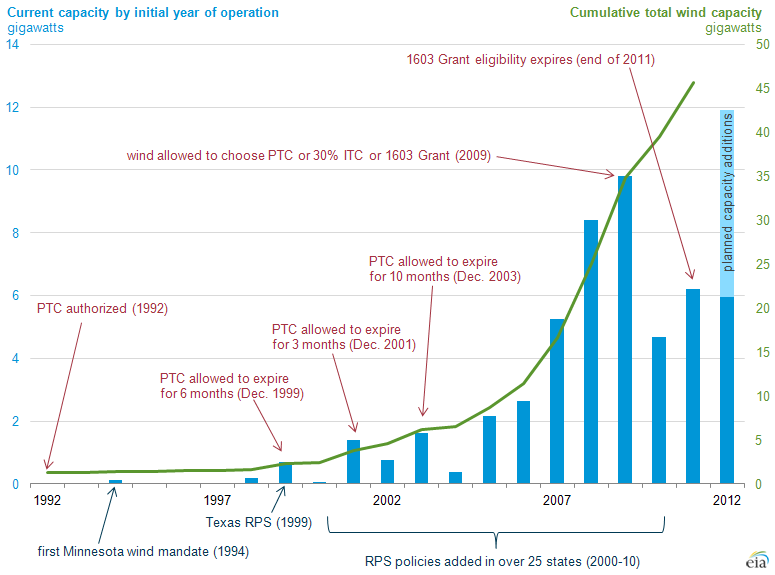
In the U. S., renewable energy has received subsidies in the form of an investment tax credit (a credit favoring investment in new facilities to promote construction) or a production tax credit (PTC; a credit based on the amount of energy delivered once a facility is operating).  Wind energy has received tax credits, much in the form of PTCs.  In the recent decade the U. S. Congress allowed credits to lapse, and then reinstated them, in an arresting pattern of fits and starts.  This is shown for wind energy in the following graphic:
 
 
History of ITCs and PTCs for wind energy in the U. S. The blue bars show annual wind generating capacity added each year, using the scale for gigawatts added shown on the left vertical axis.  The light blue section of the bar for 2012 shows planned capacity additions at the time this report was prepared late in 2012, presumably in anticipation of the expiration of the PTC at the end of 2012.  The green line shows the total wind capacity installed in the U. S., using the values on the right-hand vertical axis.  The 1603 Grant was a provision of the American Recovery and Reinvestment Act of 2009 (the “stimulus” combating the recession) that made a fractional direct cash payment for renewable energy projects.
 
It is quite clear from this graphic that periodic expiration of tax credits (see the years following expirations in 1999, 2001, 2003, and 2009) had drastic negative impacts on installation of new generating capacity during the following year.  In addition, as noted in the legend to the graphic, during 2012 wind industry planners were factoring in a scheduled termination of the PTC effective at the end of the year by accelerating new construction.
 
Extension of Renewable Energy Tax Credits.  The so-called “fiscal cliff” in the U. S. raised the possibility of sharply higher taxes and reduced spending as of Jan. 1, 2013.  At literally the last minute, in an effort to avoid this fiscal crisis, the U. S. Congress passed the American Taxpayer Relief Act of 2012 (the “Act”) on Jan. 1, 2013, and President Obama signed it into law on Jan. 3. 
 
In addition to provisions averting many facets of the looming fiscal disaster, the Act included provisions extending tax credits for renewable energy.
 
Renewable Energy Provisions of the Act.  The Act provides extensions of tax credits with slightly more favorable terms than in previous years.  Most of the provisions are summarized here.
 
a)     A production tax credit or an investment tax credit for wind energy is extended for one year ending Dec. 31, 2013, but the terms are liberalized by requiring only that construction must have begun by that date rather than, in earlier versions, been completed by then.  A total of $12 billion may benefit the wind industry over the next 10 years;
b)     a credit for energy efficiency in existing or new homes;
c)     a credit for vehicle refueling facilities providing alternative fuels;
d)     a credit for biodiesel and renewable diesel fuel mixtures, applied to fuels sold after Dec. 31, 2011 and by Dec. 31, 2013;
e)     for the four tax credits described above, the deadline is extended to Dec. 31, 2013, but the subject of the credit must have become available for use after Dec. 31, 2011.  Thus they are retroactive for about one year, and expire after one year;
f)      a credit for producing cellulosic biofuels after Dec. 31, 2008 and before Jan. 1, 2014, applicable to a wide range of newer cellulosic sources and to cultivated algae; thus this provision is retroactive for four years and remains effective for one year.  There is also a special allowance for facilities that produce the newer cellulosic or algal biofuels, placed in service after Dec. 31, 2012 and effective for one year; and
g)     a credit for geothermal facilities whose construction begins before Jan. 1, 2014.
 
The New York Times reports that electricity produced from other forms of renewable energy sources, including tides and ocean waves, landfill methane and hydroelectric facilities were also included in the tax credits.
 
Analysis

Extension of Tax Credits. The American Taxpayer Relief Act of 2012 included several provisions extending PTCs or ITCs for the relatively short period of 1 year, as itemized in this post.  This 1-year extension contributes, albeit only briefly, to helping wind energy and other renewable energy technologies to provide an increased share of America’s energy demand.  In a report issued in July 2008, The Office of Energy Efficiency and Renewable Energy of the U. S. Department of Energy modeled a scenario (EERE) in which wind energy would supply 20% of U. S. demand by 2030.  To achieve this objective, generating capacity would have to expand from about 46 gigawatts (GW) in 2011 (see graphic above) to 305 GW in 2030 (EERE).
 
The legislative wrangling over whether, and how, the fiscal cliff could be averted was itself a cliffhanger.  It was not until the last days before the fiscal cliff deadline of Jan. 1, 2013 that the outlines of the law were assembled, and final passage required a late night session of the lower chamber, the House of Representatives, on New Year’s Eve extending into the early hours of the new year.  Most of the renewable energy credits were extended for only one year.  Thus the Act guarantees yet another period of uncertainty promising yet another contentious legislative struggle over further extensions in one year’s time.  Nevertheless the Act liberalized the credits by extending them to projects whose construction will have begun before the expiration date, replacing the earlier requirement that projects must have been completed by the deadline date.
 
Policymaking by fits and starts is highly disruptive.  Governing in this way, by awarding and withdrawing tax benefits literally at the last minute on a schedule of once a year to once every few years, is extremely disruptive for business activity (see the graphic above).  Corporations and entrepreneurs seeking to develop renewable energy need multi-year periods for planning, funding, and installing renewable energy facilities.  Depending on the particular technology and location, this can include factors such as gaining zoning and siting approval, undergoing environmental impact analysis, assembling financing, garnering purchase contracts for the energy ultimately produced by the renewable source, and construction.  For example, according to the American Wind Energy Association, developing a new wind farm requires 18-24 months.  Many of these factors are interdependent.  Singly or in conjunction with one another, settling these arrangements requires extended periods of time.  It is highly counterproductive for developers to have to contend with short-term provision and expiration of tax credits.  Effective energy policy must create long-term stability in order to enable the justified expansion of renewable energy technologies.
 
It would be far more reasonable and effective to develop policies on subsidizing the development of renewable energy on a long-term schedule. In this way corporations and entrepreneurs could plan the development and implementation of projects secure that subsidy policies were intact, available as scheduled, and could be used as appropriate throughout the lifetime of the project.

This view conforms with the history of the use of subsidies in the
U. S. for newly emerging energy technologies throughout this country’s history, beginning in the nineteenth century. Federal and/or state subsidies were consistently applied, and have been found to be most effective when a new technology was in the  early years of its development.  Unfortunately, at least in the case of crude oil, subsidies continue to be granted even now, more than 100 years after the birth of the industry. Clearly, subsidies are no longer warranted for this industry, given the enormous revenues and profits among the major crude oil producers.  Those expenditures could more justifiably be applied to the current group of nascent technologies encompassed within renewable energy.
 
Advantages of renewable energy.  Construction and development of renewable energy projects have many positive policy features. The new facilities will operate within the U. S., rather than abroad.  In contrast, much new petroleum exploration and development  occurs in more and more remote locations and environments.  Commonly these require deep drilling and frequently involve deep sea operations including development in the extreme conditions of Arctic oceans.  These conditions are fraught with environmental hazards that can come to fruition with disastrous consequences. Furthermore, as drilling operations take place under increasingly challenging technical conditions, their costs increase correspondingly.  In contrast, the costs for renewable energy are well-understood and easily budgeted.
 
Developing renewable energy preserves and/or creates jobs.  The American Wind Energy Association states that currently 75,000 workers are engaged in wind energy.  It expects that the policies in the Act could save as many as 37,000 of those jobs and create many more in later years.  There are almost 500 manufacturing facilities in the U. S. related to wind energy, located in all 50 states.  A thorough summary of job economics related to renewable energy is presented in this post.
 
Renewable energy sources have the very important feature of not emitting greenhouse gases into the atmosphere.  Global warming due to manmade greenhouse gases is already a very serious problem and is destined to get worse as humanity's demand for more energy grows. New fossil fuel-based energy- facilities put into service now, such as oil and gas pipelines, electric generating plants, oil refineries, and the like, will continue operating for a useful lifetime of, say, 40-50 years.  These new facilities will continue spewing greenhouse gases into the atmosphere throughout their service lifetime, adding to those already accumulated and worsening global warming.  In contrast, renewable energy facilities, once placed in service, have close to zero lifetime emissions of greenhouse gases, yet have the potential capacity to provide a significant portion of America’s energy demand.

The American Taxpayer Relief Act of 2012 laudably includes a one-year extension of tax credits for wind energy and other forms of renewable energy.  It is lamented that the extension is for only one year.  This prevents entrepreneurs and businesses from making plans for further development of renewable energy with the certainty of having a long-term policy in place.  The expanding renewable energy industry provides jobs for American workers, contributes to freedom from reliance on foreign sources of energy, and relieves the burden of accumulating greenhouse gas emissions in proportion to its installed generating capacity.  All efforts should be undertaken to implement a long-term energy policy in the U. S. that includes appropriate support for the expansion of renewable energy.

 
© 2012 Henry Auer

Tuesday, December 4, 2012

Hurricane Sandy: Economic Costs and Global Warming


Summary.  Hurricane Sandy struck the state of New Jersey and the New York metropolitan area on Monday October 29, 2012.  It caused damage estimated to range as high as US$50 billion, much of it due to storm surges that impacted wide stretches of shoreline in New Jersey, the heart of New York City, and eastward along New York and Connecticut. 

The ravages of the storm could be due to factors related to global warming, such as increases in the moisture content of air over warm ocean waters, rising sea levels, and a blocking high pressure system that forced the path of the storm toward land.

Global warming is expected to worsen the impacts of extreme weather events such as Hurricane Sandy.  Society is faced with the prospect of having to remediate their effects as emergency situations each time one occurs.  Costs of such efforts affect us all, since they ultimately create a demand for higher taxes and for higher insurance premiums.  An alternative would be to undertake investments now to eliminate fossil fuels from our energy economy.  The sooner the world decarbonizes its energy usage, the smaller the accumulated level of atmospheric greenhouse gases will be, and the less harmful will be the effects of global warming on the people of the world.

 
Hurricane Sandy was an extensive and highly damaging storm that crossed from its ocean track onto land in New Jersey on Monday October 29, 2012.  Its characteristics, contributing to the high damage it caused, were the very large area it covered and the very high storm surge that it generated.  In addition, its winds, while not as high as those of other hurricanes, brought down many trees that severed electricity service, damaged homes, and even directly caused some deaths.

Why was Sandy destructive?  The climate science underlying the warming of the planet provides predictions, or scenarios, in terms of probabilities of trends occurring over long time periods and spanning wide regions of the planet.  Long term projections of future trends in the climate are not able to ascribe causes for short term weather events, such as hurricanes, with certainty.  In addition, not enough time has passed as of this writing for climate scientists to assess Hurricane Sandy in terms of its relationship to the warming of the planet.

Nevertheless, three factors from warming involved in hurricane activity include increased moisture content of air, higher sea level, and a weather block that caused the storm to shift its course.  First, as water temperatures get warmer, the absolute amount of water vapor that the air above it can hold increases by about 7% per ºC (about 4% per ºF) (for any temperature, this amount defines 100% on the scale of relative humidity).  As the ocean surface warms, a storm such as a hurricane picks up more water vapor which can be deposited as rain as the storm proceeds.

Second, sea levels have been rising since the industrial revolution began. Glaciers and land-based ice sheets have been melting, contributing new water to the oceans; this is attributed at least partly to global warming.  Also, water expands by about 0.026% per ºC at 25 ºC (0.015% per ºF at 77 ºF).  This expansion can proceed only upwards.  Although this percentage may seem insignificant, increased temperatures of ocean surface water penetrate to sufficient depths that expansion occurs throughout this layer.  This results in measurable increases in sea level as the earth warms.  The long-term rise in global average sea levels is shown below for the period 1870 to  2000.


Global average sea level trend from 1880 to 2000, referenced to a zero value given as the average for the period from 1961 to 1990, in mm.
Source: Intergovernmental Panel on Climate Change, 4th Assessment Report, 2007; http://www.ipcc.ch/publications_and_data/ar4/syr/en/figure-spm-1.html.
 

It is seen that over this interval the global average sea level has increased by about 190 mm (7.5 in.).  Furthermore, a report published on Nov. 28, 2012 finds that sea levels have been increasing in recent decades even faster than predicted earlier by the Intergovernmental Panel on Climate Change. 

Third, the path followed by Hurricane Sandy was not typical for Atlantic hurricanes.  They usually track northeastward following the coast of the eastern U. S.  Sandy took an abrupt shift westward after following a northeastward path, due to the presence of a blocking high pressure air mass over eastern Canada and Greenland.  It is possible that the this blocking high was present as a result of an Arctic summer in which more sea ice melted this summer than ever recorded previously.  Loss of ice results in absorbing more heat from sunlight during the Arctic summer than when more ice is present.  It is possible that this altered weather over the Arctic placed the blocking high in Sandy’s path, a pattern that would not have been present without the exceptional extent of melting of Arctic sea ice.

These and other factors contributed to an unprecedented extent of damage from the storm surge accompanying Hurricane Sandy; there was also damage and economic loss inland including massive losses of electric power.  Coincidentally, a report by Grinsted and coworkers (submitted for publication some months earlier) appeared in the Proceedings of the (U. S.) National Academy of Sciences (commentary here) .  They surveyed records of storm surges from previous hurricanes and found, using a storm surge index, that hurricane-associated storm surges have increased recently in correlation with the increase in the global temperature.  They found that the highest values of the index occurred with the most extreme storm events.  More generally, climate scientists foresee that the intensity, and possibly the number, of severe tropical storms will increase as global warming proceeds.

The economic costs of Hurricane Sandy are hard to estimate, but are extremely high.  The New York Times reports that New York’s Governor Andrew Cuomo and New Jersey’s Governor Chris Christie together have assembled the aggregate damage assessment of US$71 billion.  They intend to petition the U. S. federal government for assistance in meeting these emergency expenses.  This sum includes US$9 billion estimated by Gov. Cuomo to construct new facilities and devices intended to mitigate any new threat of more intense, more damaging storms in the future.  Gov. Cuomo broke down his damage estimates in some detail , itemizing the categories of government response, individual assistance, housing, business impact, health, schools, transit, roads and bridges, parks and the environment, water, waste and sewer, utilities, and government operation revenue.  He estimated that the storm destroyed or damaged 305,000 housing units, caused 2,190,000 customers to lose power, and impacted   265,300 businesses.  Overall, in 16 states 8,510,000 million customers lost power. 

Gov. Christie issued a preliminary estimate of damage in New Jersey of US$29.4 billion.  His estimates included personal property, businesses, transportation, utilities infrastructure, and effects on the state’s tourism industry.  As is likely true for all areas impacted by the storm, more long-term effects include loss of economic activity, induced population shifts and impacts on the value of real estate.  [Addendum on Dec. 5, 2012:  ADP, the payroll processing firm, estimated that for the month of November, 86,000 jobs were lost because of the hurricane.  Losses were highest in manufacturing, retailing, leisure and hospitality, and temporary help industries.]

Insured losses from Sandy estimated by three firms fall in the range of US$16-25 billion, according to Zacks Equity Research.  In addition, one of the firms estimated that lost economic activity can be estimated at US$50 billion; these typically are uninsured and cannot be recovered.  Many large insurance companies that cover losses in the area hit by the storm have indicated that their ability to absorb the benefit payments due from their coverages exceed their capacity.  [Addendum on Dec. 5, 2012:  For instance, the insurance companies Travelers Corp. and Allstate report that losses they sustained due to Hurricdane Sandy are each over US$1 billion. ]


Analysis

Extreme weather events such as Hurricane Sandy appear to be increasing in number and severity in recent years, in conjunction with the increasing global average temperature.  This pattern is consistent with the expectations from climate modeling for a warming planet, which foresees, at various locations on the surface of the earth, more intense storms, increasing rainfall with flooding, and more extreme heat waves with drought.  Previous posts have surveyed the economic consequences of earlier extreme weather in the U. S.  and globally.

Global warming and its harmful consequences for humanity reflect not the annual rate of emission of greenhouse gases, but rather their total concentration accumulated in the atmosphere.  As long as even low annual rates of emission continue, the accumulated total continues to grow.  Accumulated atmospheric greenhouse gases determine the extent of global warming.  Carbon dioxide, the principal greenhouse gas, remains in the atmosphere for decades or centuries.  Therefore the greenhouse gas level cannot retreat to values we experienced in earlier decades.  We are stuck with the greenhouse gases currently present, and the extent of global warming they confer, indefinitely.  If the world wishes to stabilize the global average temperature, necessarily at a new, higher value, we must work toward developing a zero-carbon energy economy. 

Each extreme weather event is a natural disaster inflicting enormous damage, both physical and economic, on its victims.  Societal harms also arise as social and local economic structures are disrupted.  Each event brings with it the need for compensation at a large scale to help victims recover and restore their lives and livelihoods.  Eventually all citizens pay for this, because relief comes from governments, insurance benefits, and private charities.  Costs attributed to governments potentially lead to higher taxes that we all bear, and insurance benefit payments lead to higher premiums that many of us will pay.

The alternative to unscheduled needs for emergency response to extreme weather events is to invest in creating a carbon-free energy economy. All nations of the world should be striving to achieve a zero emissions energy economy as soon as possible.  This means that instead of creating the need for even more emergency relief by continuing “business-as-usual”, we invest early in zero carbon energy.  These investments will help stabilize the atmospheric level of greenhouse gases at lower levels, so that warming of the planet is attenuated.

© 2012 Henry Auer