See the Tabbed Pages for links to video tutorials, and a linked list of post titles grouped by topic.

This blog is expressly directed to readers who do not have strong training or backgrounds in science, with the intent of helping them grasp the underpinnings of this important issue. I'm going to present an ongoing series of posts that will develop various aspects of the science of global warming, its causes and possible methods for minimizing its advance and overcoming at least partially its detrimental effects.

Each post will begin with a capsule summary. It will then proceed with captioned sections to amplify and justify the statements and conclusions of the summary. I'll present images and tables where helpful to develop a point, since "a picture is worth a thousand words".

Showing posts with label adaptation. Show all posts

Wednesday, December 18, 2019

“U.N. Climate Talks End With Few Commitments and a ‘Lost’ Opportunity”

“U.N. Climate Talks End With Few Commitments and a ‘Lost’ Opportunity” is the heading in the New York Times, December 15, 2019, reporting on the largely failed conclusion to the annual UN climate conference held in Madrid, Spain.  Recent annual meetings are follow-ups to the conference in Paris four years earlier, which produced the 2015 Paris Agreement on reducing greenhouse gas (GHG) emissions.  It was agreed to by the almost 200 member nations of the UN, and has the goal of keeping the increase in the long-term global average temperature below 2°C (3.6°F) above the pre-industrial temperature.  It also included the hope that the limit could be more stringent, keeping the increase below 1.5°C.

The Agreement is intended to minimize further global warming and the resulting harms to the world’s climate.  Warming arises because the growth in the world’s economies in the last 1½-2 centuries has relied largely on energy derived by burning carbon-containing fuels (fossil fuels: coal, petroleum and natural gas) that release carbon dioxide (CO2; a GHG) when burned.  The added CO2 accumulates in the atmosphere and remains there for centuries, producing increased temperatures by an atmospheric greenhouse effect.  China’s dramatic economic growth over the past 3 decades, for example, closely parallels its growth in use of fossil fuels and other energy sources.
The nations of the UN signed on to the Paris Agreement because, in contrast to the earlier Kyoto Protocol, each nation’s contribution to reducing emissions is voluntary.  Analysis of those contributions at the time (Fawcett and coworkers, 2015) already showed, however, that they were inadequate to produce the GHG reductions needed to stay within the 2°C limit.
One objective at the Madrid 2019 gathering was for the nations to generate more ambitious goals to reduce GHG emission rates that would lead to compliance with the Paris Agreement limit.  Recently the U. S. under President Trump has stated its intention to withdraw entirely from the Agreement, to take effect just before the next meeting in 2020.  As the New York Times reports, for this reason “…it was the last chance, at least for some time, for [America to negotiate] — and perhaps a turning point in global climate negotiations, given the influence that Washington has long wielded…in the discussions.” 
But the U. S. was not alone in hindering progress. Helen Mountford, a vice president at World Resources Institute, said “[m]ost of the large emitters were missing in action or obstructive.”  Nations with significant rates of GHG emissions, including China and India, “balked at suggestions of more ambitious climate targets next year.”
Ms. Mountford further lamented that the failure to act in Madrid “reflects how disconnected many national leaders are from the urgency of the science and the demands of their citizens.”
“The urgency of the science” is apparent in reviews of the worsening warming and climate appearing in rapid succession in the past year.  The Intergovernmental Panel on Climate Change (IPCC) issued its report , “Global warming of 1.5°C - - An IPCC Special Report on the impacts of global warming of 1.5°C above pre-industrial levels and related global greenhouse gas emission pathways, in the context of strengthening the global response to the threat of climate change, sustainable development, and efforts to eradicate poverty” in October 2018.  The IPCC reports that in the three years since the Paris Agreement, atmospheric GHG content and temperatures were rising faster than foreseen earlier.  Therefore it feels we must bring worldwide GHG emissions to near zero by about 2040, earlier than recommended in previous reviews.
The Arctic is warming twice as fast as elsewhere on Earth, the National Oceanic and Atmospheric Administration reported in December 2019. This finding has significance throughout the world, because the warmer temperatures are now melting the Greenland Ice Sheet very rapidly.  In the 1990’s melting ice was roughly balanced by new precipitation.  But by the 2010’s net loss of ice occurred due both to excessive surface melting and faster glacier calving.  Overall, ice loss from Greenland alone contributed 10 mm (0.4 in) to global sea level rise in this period.
Oceans absorb about 90% of the excess heat retained by the earth, by transfer of the heat from the atmosphere to the water.  This heating has accelerated in recent years.  Water expands as it warms, contributing an additional amount to sea level rise.  Changing temperatures in the oceans have led to coral die-offs (some of which is not recovered), and to changes in the species distribution of sea animals because they are exquisitely sensitive to the ocean temperature.  This impacts human fishing productivity.  Warm water also evaporates more moisture into the air, making hurricanes more violent and releasing more rainfall, as has been observed in recent years.
“The demands of [nations’] citizens” have grown more insistent in the past year.  The teenage climate activist Greta Thunberg, recently named TIME magazine’s Person of the Year, has stimulated a worldwide climate movement among youth, and adults.  Our children understand that they will experience the climate extremes resulting from adults’ climate inaction.  The Madrid meeting shows that the world’s resolve meaningfully to combat global warming and climate change appears compromised by the absence of international political will, presumably abetted by economic factors and fossil fuel commercial interests. 
But optimism persists nevertheless.  As Ms. Thunberg concluded in her speech to Madrid attendees, “[T]here is hope….It does not come from the government or corporations.  It comes from the people….People are ready for change….Every great change …come[s] from the people.”

© 2019 Henry Auer

Tuesday, August 15, 2017

The Earth Continues Warming: The Fourth National Climate Assessment Draft Report

Summary


A draft of the Fourth National Climate Assessment reports that the global average temperature for the 30-year period from 1986 to 2016 rose by 1.2°F (0.7°C). It is extremely likely that activities by humans have been the principal cause of this warming. Extreme temperature and rainfall events have increased over this time, as have forest wildfires.
 

Arctic land-based ice has been lost to melting, and the extent and thickness of sea ice has decreased.  The mean sea level has risen about 7-8 in (about 26-21 cm) since 1900.  Ocean waters have taken up 93% of the excess heat of the Earth system due to global warming since the 1950s.
 
Global greenhouse gas emissions are projected to continue and consequently global temperatures will continue increasing and related trends will continue.  Limits to the intended increase require that humanity reduce annual emissions to zero by 2100. 
 
The draft states “Choices made today will determine the magnitude of climate change risks beyond the next few decades.”

The Fourth National Climate Assessment (NCA) is due in 2018 (See Background at the end of this post).  However the U.S. Global Change Research Program (USGCRP), which oversees preparation of the NCA, has prepared a Final Draft of a Climate Science Special Report (CSSR; see Note 1 at the end of the post) that has become publicly available as a freestanding document on which the actual NCA will be based.
 
This post is based on the CSSR Executive Summary (ES).  Confidence levels and likelihoods given here in italics are taken directly from the ES.  They are carefully defined in the CSSR.  Phrases in quotes are taken verbatim from the CSSR text.

The Historical Record

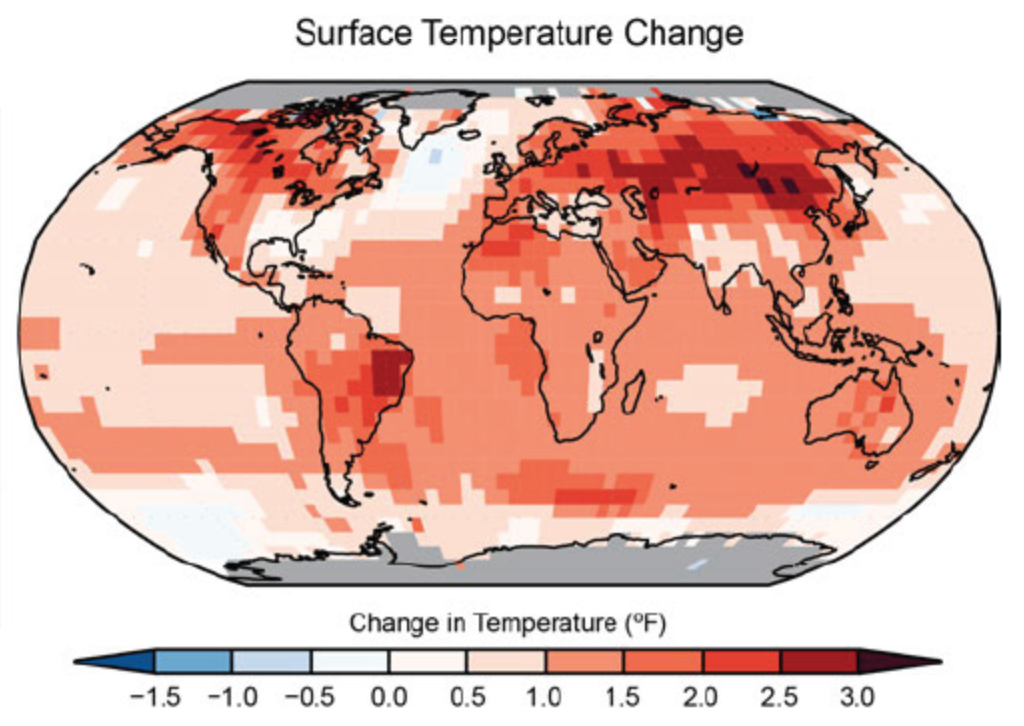
The global average temperature has risen above the average for the six decades 1901-1960 by 1.2°F (0.7°C) for the recent period from 1986 to 2016 (very high confidence). The map below shows temperature increases gridded across the globe.

Color-coded global map grid of historical changes in the average temperature for the period 1986-2016 relative to the average from the six-decade reference period 1901-1960, in °F. No data are available at the poles, indicated by gray.
Source: CSSR; https://www.nytimes.com/interactive/2017/08/07/climate/document-Draft-of-the-Climate-Science-Special-Report.html.


The map shows that since the reference decades the entire surface of the planet, both land and sea, has increased in regional average temperature.  The greatest increase has occurred in Canada (especially in the northern and Arctic regions), Alaska, Siberia, northeastern China and eastern Brazil. Indeed, the Arctic is warming about twice as fast as the global average.
It is extremely likely that activities by humans have been the “dominant” cause of the warming observed since the middle of the 20th century.  No alternatives, such as the cyclical changes in solar energy reaching the Earth or variations in natural planetary factors, can explain the observed climate changes (very high confidence).

Extreme climate-related weather events have increased in number and severity.  Since 1980 the cost of such calamities in the U. S. is over US$1 trillion. Extreme events can impact water quality, agriculture, human health, infrastructure, and lead to disaster events.  In the U. S. the number of high temperature records in the past 20 years is much higher than the number of low temperature records (very high confidence).

Heavy precipitation events in most regions of the U. S. have increased in intensity and frequency since 1901, especially in the northeast. (high confidence). 
The occurrence of large forest wildfires has increased in the U. S. West and Alaska since the early 1980s (high confidence). 

The waters of the oceans have absorbed about 93% of the heat accumulating in the Earth system due to global warming since the 1950s (very high confidence).  This affects climate patterns around the world.

In the Arctic, ice sheets overlaying land have been melting for at least the last three decades; in some locations the rate of loss is accelerating (very high confidence).    The rate of melting of ice sheets over Greenland has accelerated in the last few years (high confidence).  As this ice melts the water flows to the ocean, resulting in a net increase of sea level.

Arctic sea ice has been imaged since satellite flights permitted. The sea ice floats on the Arctic Ocean; its area expands and contracts in freeze-thaw seasonal cycles without any net change to global sea levels.  Rather, the extent responds to changes in air and sea temperatures.  The least extent, i.e., the most melting, occurs typically in September.  Striking images showing the loss of September sea ice from 1984 to 2016, both in thickness (color coded white as having been formed at least four years earlier) and in overall surface area, are shown in the images below:

Satellite images of Arctic sea ice extent and thickness in September, for 1984 (top) and 2016 (bottom).  The color bar shows the local age of the ice in years, a proxy for its thickness, from recent (dark gray) to more than 4 years (white).
Source: Adapted from CSSR; https://www.nytimes.com/interactive/2017/08/07/climate/document-Draft-of-the-Climate-Science-Special-Report.html.

 
Sea ice thickness has decreased by between 4.3 and 7.5 feet.  September sea ice extent has decreased by 10.7% to 15.9% per decade (very high confidence).  These changes reflect warming of the Arctic region over this time frame.  It is virtually certain that human activity has contributed to Arctic surface temperature increases, sea ice loss, glacier mass loss and snow extent decline seen across the Arctic (very high confidence).
The mean sea level has risen about 7-8 in (about 26-21 cm) since 1900 (very high confidence).  This is attributed “substantially” to human-induced climate change (high confidence).  The rate of sea level rise is greater than any found in the last 2,800 years (medium confidence).

Ocean waters are absorbing more than 25% of the carbon dioxide emitted into the atmosphere by burning fossil fuels.  Carbon dioxide is weakly acidic when dissolved in water, increasing its acidity (very high confidence).  This negatively impacts marine ecosystems in many important ways.

Projected Future Climate Trends
 
Extreme climate-related weather events will continue for many decades.
By the end of the 21st century if the world generates significant reductions in greenhouse gases the global average temperature increase could be limited to 3.6°F (2.0°C) or less. This would require a pathway of annual GHG emissions reaching near zero by then.  In contrast, minimal constraints on the annual emissions rate could result in a rise of 5.8-11.9°F (3.2-6.6°C) (high confidence).

Even if the annual rate of greenhouse gas (GHG) emissions were to fall to zero, the high burden of GHGs already accumulated in the atmosphere would persist for a long time.  The CSSR foresees that even in this event the global average temperature would rise further (high confidence), perhaps by an additional 1.1°F (0.6°C) (medium confidence).
But realistic projections all foresee continued GHG emissions into the future.  U. S. temperatures will continue to rise (very high confidence); new records for high temperatures will be frequent (virtually certain).  Temperatures by the end of this century will be much higher than the present (high confidence).
Heavy precipitation events are projected to continue increasing over the 21st century (high confidence).  In the western U. S., large reductions in mountain snowpack, and more precipitation falling as rain rather than snow, are projected as the climate warms (high confidence). These trends are attributed to human activity (high confidence).  They will likely worsen considerably as the climate warms (very high confidence).  In the absence of reductions in emission rates long-duration hydrological drought, due to decreased retention of soil moisture, becomes more likely by the end of the century (very high confidence).

Further warming is projected to lead to increases in wildfires (medium confidence).
 
If GHG emission rates continue unconstrained, the average sea surface temperature is projected to increase about 4.9°F (about 2.7°C) by 2100 (very high confidence).

The mean sea level will continue increasing, to varying extents depending on future emission rates, by at least 1 ft (30 cm; very high confidence) and as much as 4 ft (130 cm; low confidence) by 2100.  If the Antarctic ice shelf is lost due to high emission rates the upper bound could be as high as 8 ft (260 cm).  It is extremely likely that sea level will continue rising beyond 2100 (high confidence) as ice continues melting.
Further loss in Arctic sea ice will continue throughout the 21st century, very likely resulting in a virtually ice-free ocean by the 2040s (very high confidence).

Conclusions of the CSSR
 
Limiting the total global average temperature increase to 3.6°F (2.0°C), or less, from a 19th century baseline will require significant constraints on future GHG emission rates. Even though annual emission rates decreased slightly in 2014 and 2015, they are still too high to meet commitments that nations made upon entering the 2015 Paris Agreement (high confidence).  Indeed, present and projected emission rates would bring the atmospheric level of GHGs to levels so high that they have not occurred for at least the last 50 million years (medium confidence).

New carbon dioxide released “today” is long-lived, persisting in the atmosphere for decades to thousands of years. Therefore it’s important to note that the relationship between total atmospheric CO2 concentration and the increase in global temperature is a linear one. 

The ES states “Choices made today will determine the magnitude of climate change risks beyond the next few decades.  Stabilizing global mean temperature below 3.6°F (2°C) or lower relative to preindustrial levels requires significant reductions in …CO2 emissions…before 2040 and likely requires net emissions to become zero….”  If humanity continues emitting GHGs at rates higher than called for here we would reach the 3.6°F limit only two decades from now, with further temperature increases later.
Finally, changes that are unanticipated or difficult or impossible to manage, may arise during the next century.  Examples are complex (or simultaneously occurring) phenomena, and self-reinforcing changes (positive feedbacks).  Such occurrences would accelerate the world’s changes to points beyond the accepted CO2 temperature limits.

Analysis

Issuance of this NCA is mandated by an act of Congress.  It is important that this Final Draft, the CSSR, continue on its bureaucratic trajectory and be issued on schedule in 2018.  Yet some of the scientists contributing to the Draft hold positions in departments or agencies whose heads have expressed disdain or opposition to the phenomenon of global warming, the Paris Climate Agreement, have acted to reverse federal policies that limit extraction and use of fossil fuels, or have deleted pages concerning global warming from their agency’s websites.  They all work in an administration whose head has declared global warming to be a hoax. These situations potentially place the contributing scientists in conflicting positions.  Their work is commendable and should be supported.  The NCA should be issued without being altered, nor should it be suppressed.


[Update August 17, 2017: The science journal Nature has published a news article that discusses the CSSR and the political considerations facing the U. S. administration as it weighs issuing the Fourth NCA. Climate scientists are concerned about the fate of the Report. Nature notes that the Heartland Institute, a conservative think tank that promotes skepticism about global warming, is consulting with the Environmental Protection Agency on this issue.]
 
This NCA is only the latest in a long series of reports detailing the reality of warming and specifying the harms that global warming and climate change cause to our planet.  In particular, it attributes the cause to human activity, including the burning of fossil fuels. 

We must all undertake to reduce emissions of GHGs in our personal lives, and support policies promoting reductions at the state, national and international levels.
 
Background

The U. S. Global Change Research Act of 1990 mandates preparation of assessments of global change every four years to “assist the nation and the world to understand, assess, predict, and respond to human-induced and natural processes of global change”.  It assesses the current state of scientific understanding of global change on the natural and human environments. Its tasks, however, do not include formulation of policies to address global warming.
Climate scientists and related specialists drawn from thirteen U. S. government departments and agencies (see Note 2 at the end of this post), as well as a large number of scientists in nongovernmental research facilities, prepared the CSSR and the NCA. They critically assessed peer-reviewed research and similar public sources, including primary datasets and recognized climate modeling frameworks.

 
Notes

1.    USGCRP, 2017: Climate Science Special Report: A Sustained Assessment Activity of the U.S. Global Change Research Program [Wuebbles, D.J., D.W. Fahey, K.A. Hibbard, D.J. Dokken, B.C. Stewart, and T.K. Maycock (eds.)]. U.S. Global Change Research Program, Washington, DC, USA, 669 pp.
 
2.    The federal scientists involved in preparing the NCA and the CSSR are drawn from the:  

Department of Agriculture,
Department of Commerce (National Oceanic and Atmospheric Administration),
Department of Defense,
Department of Energy,
Department of Health and Human Services,
Department of the Interior,
Department of State,
Department of Transportation,
Environmental Protection Agency,
National Aeronautics and Space Administration,
National Science Foundation,
Smithsonian Institution, and
U.S. Agency for International Development.      

© 20
17 Henry Auer

Thursday, March 17, 2016

Attribution of Extreme Events to Global Warming


The public, when contemplating global warming, includes those who question whether warming underlies the occurrence of extreme weather and climate events.  The U.S. National Academies of Science, Engineering and Medicine recently issued a report, “Attribution of Extreme Weather Events in the Context of Climate Change”.  It emphasizes that the appropriate format for questions concerning this issue can be phrased in terms such as “Are events of this severity becoming more or less likely because of climate change?” 

The report emphasizes that because of rapid advances in data analysis and climate modeling the severity of many extreme events can be attributed to contributing factors arising from warming.  It includes a schematic image, shown here, characterizing how the increasing degree of understanding of various types of events leads to increasing confidence in the degree to which we can attribute severity to contributions from global warming.

This post concludes with a selection of examples from the climate literature where such analyses have been made, leading to affirmative statements of attribution such as considered here.


Recently weather news has reported on extreme events in many regions of the world. 

  • The American states of Texas and Louisiana, and their neighbors, had intense rain for over a week in early 2016, triggering record-breaking flooding in the area.    
  • The American West has suffered severe drought conditions for four years, straining water supplies and lowering yields of important crops. 
  • Perth, Australia had a heat wave four days long with temperatures over 40ºC (104ºF) in February 2016, and has had seven days over this temperature this season.  
  • Pakistan has had increasing numbers of serious flooding events over the last century, including 40 events in the last 15 years.  Most of these are accompanied by loss of life and social dislocation, and significant damage to structures and agricultural lands.
These few anecdotes are potentially significant indicators of the effect that global warming is having at regional and local levels around the world.  Indeed, increased rates of occurrence of such phenomena are predicted with high confidence in recent global warming reports.  But in discussing the role of warming at the scale of such geographically small areas it is important to evaluate whether each one in fact is related to warming.  For example, if few or none are, climate science would be hard pressed to persuade policymakers and the public to undertake efforts to minimize further warming and adapt to its effects.  On the other hand, if it can be shown that there is indeed a contribution from warming, then climate science is justified in actively pursuing appropriate policies such as those agreed to at the United Nations conference in Paris in December 2015.

Here we discuss the question of whether, and how, extreme events can be attributed to global warming.

The U. S. National Academies of Sciences, Engineering, and Medicine issued the report “Attribution of Extreme Weather Events in the Context of Climate Change” (2016); Washington, DC: The National Academies Press (the Report) on March 10, 2016.  The Report emphasizes that extreme events, just as all our weather every day, results from the interactions of many atmospheric forces and processes.  For this reason, it makes the very important point that we can not justifiably ask a question such as “Was this extreme event caused by [man-made] climate change, yes or no?”  Such a simplified black-or-white question overlooks the complexity in climate and weather. 

Rather the Report offers different questions phrased as “Are events of this severity becoming more or less likely because of climate change?”; or, for single events such as local storms, the question could be “To what extent was the storm intensified, or its precipitation increased, because of climate change?”  Note that the questions deemed appropriate seek expressions of likelihood, rather than the certainty demanded by the yes-or-no question.  To any viewer of a televised weather forecast this should hardly be surprising.  After all, these daily predictions always provide likelihoods for sunshine (clear, partly cloudy, mostly cloudy, etc.) as well as percent probabilities of rain, sleet or snow.  In the same way, and for the same reasons, the Report concludes that statements of attribution should be phrased in terms of the probability or likelihood that global warming was a climatic factor contributing to the occurrence of the extreme event.

The Report summarizes its detailed deliberations about attribution of events to known or understandable contributing factors with a simplified conceptual diagram, shown here
 
Schematic diagram showing how our confidence (vertical axis) in attributing different kinds of extreme events to man-made climate change depends on our understanding of the extent to which climate change affects the particular type of event (horizontal axis).  Different types of extreme events are shown by the differently colored labeled circles.  The dashed line represents where a particular type of extreme event would fall if we had an ideal ability to attribute how climate change affects it.  In reality all the circles fall below the dashed line because our ability to attribute the specific events to man-made climate change is less than perfect.  Note that the understanding/attribution level is high for temperature events (upper right), and that these become lower as we pass through extreme rainfall (near the center) to severe convective storms (e.g., thunderstorms and tornadoes; lower left).
Source: U. S. National Academies of Sciences, Engineering, and Medicine,  “Attribution of Extreme Weather Events in the Context of Climate Change” (2016); Washington, DC: The National Academies Press. doi: 10.17226/21852.
 
 
The Report identifies two ways to label an event as “extreme”.  We have to be able to distinguish a supposed extreme event, potentially caused in part by the effects of global warming, from normal behavior.  First, data characterizing the event could be shown to differ from comparable data for a reference period extending over a sufficiently long period of time, with a high level of statistical significance.  Alternatively, data characterizing the event could be successfully modeled in a climate model that includes man-made global warming factors, whereas it could not be modeled by a similar model run excluding those factors, again, with a high level of statistical significance.  An event that fulfils either of these conditions can then be labeled as an event to which global warming contributes to its extreme character.
 
Extreme events had already been attributed to global warming before this Report. 
 
  • Analysis of data over the 49 year period from 1951-1999 shows that global warming is responsible for extremes of rainfall over the Northern Hemisphere.  Min and coworkers (Nature, 2011, Vol. 470, pp. 378-381, doi:10.1038/nature09763) showed that “human-induced increases in greenhouse gases have contributed to the observed intensification of heavy precipitation events found over approximately two-thirds of … Northern Hemisphere land areas.”  This work is significant because it covers a period of time in which greenhouse gas levels, and global average temperatures, were much lower than at present.
 
  • Extreme rainfall and catastrophic flooding in England and Wales in 2000 was very likely due to human-induced global warming.  Pall and coworkers carried out a probabilistic analysis of weather patterns and likelihood of flooding in the region (Nature, 2011, Vol. 470, pp. 382-385, doi:10.1038/nature09762). During October and November 2000 England and Wales had the heaviest rainfall since records began in 1766, leading to severe flooding. The authors concluded “it is very likely that global [human-induced] greenhouse gas emissions [occurring during the twentieth century] substantially increased the risk of flood occurrence…in autumn 2000.”
 
  • Kelley and coworkers (Proc. Natl Acad. Sci., published online before print March 2, 2015) report on the worst drought in recorded history in Syria and neighboring countries just prior to the “Arab Spring”.  The drought was serious enough that large numbers of farmers left their villages and migrated to Syria’s cities.  This caused major social and political turmoil and is considered to be a contributing factor to Syria’s ongoing civil war.  The authors found that human-derived greenhouse gases contributed to the drought.
 
  • Moore and Lobell (Proc. Natl. Acad. Sci., vol. 112 no. 9, pp. 2670–2675, 2015) analyzed changes in crop yields and climate change across Europe between 1989 and 2009.  Large scale decreases in yields were found in many localized regions, which correlated with increased temperatures and decreased precipitation over the 20 year period studied.
 
  • Diffenbaugh and coworkers (Proc. Natl. Acad. Sci., published online before print March 2, 2015) examined the drought in California from December 2012 to September 2014, likely the worst in 1000 years.  By simulating the region’s climate in model calculations the authors found that the extra amount of greenhouse gases added by human activity likely resulted in higher temperatures and reduced precipitation in the region.  This factor also contributes to a high risk of continued severe droughts.
 
  • Williams and coworkers also conducted detailed analyses of climate-related data for California, from 1901 to 2014 (Geophys. Res. Let. 2015; DOI: 10.1002/2015GL064924).  From rigorous statistical analysis the authors estimated that global warming was responsible for 8-27% of the observed excess drought conditions for 2012-2014, and for 5-18% for 2014 alone.  These findings indicate that although drought conditions may originate from various climatic factors operating cyclically over many years, its full extreme extent in the current drought has been worsened by global warming, producing the current record conditions.
 
  • Cook and coworkers (Sci. Adv. 1, e1400082 (2015); published electronically 12 February 2015) assessed drought conditions in the American Southwest and Central Plains.  Assuming that unrestrained emission of greenhouse gases would continue, the risk of severe droughts in these regions is projected to be extremely high, by various measures between about 69% and 97% in the second half of this century.
 
Conclusion
 
The Report by the National Academies makes clear that climate science has advanced remarkably in the last decade, so that attributions of global warming as a contributing factor to extreme events can reliably be made after appropriate analysis.  This depends on use of one or both of the methods, either data based or model based, mentioned above.  The progress making this possible includes the availability of far more observational data, on the one hand, and constant improvements in climate models on the other.  As a result statements of attribution, when merited based on analysis, now authoritatively support the role of man-made global warming, due to humanity’s continued and increasing use of fossil fuels, in the increasing severity of various types of extreme climate and weather events.  We all, as citizens of countries around the world, must marshal our efforts to reduce emissions as aggressively as possible.  The goal should be achieving near zero annual emission rates within a few decades, say by mid-century.
 
© 2016 Henry Auer

Wednesday, May 27, 2015

President Obama Says Global Warming Harms U. S. National Security

President Barack Obama addressed the graduating class at the U. S. Coast Guard Academy on May 20, 2015.  A major theme in his remarks was that the worldwide effects of global warming negatively impact the security of the United States in its military preparedness and military operations.

The President unambiguously embraced the conclusions of the worldwide community of climate scientists that “climate change is happening….[t]the science is indisputable….The planet is getting warmer”.  He stated that humanity’s burning of fossil fuels to produce carbon dioxide, a potent greenhouse gas, is a major contributing factor to this problem. 

As an example of its effects, the President cited the melting of polar ice and the resulting rise in sea levels worldwide.  By the end of this century, he said, the sea level could rise an additional one to four feet (between 0.31 and 1.2 m).  He pointed out “…the threat of a changing climate cuts to the very core of [the Coast Guard Cadets’] service.…[C]limate change is one of [the] most severe threats” that they will face.

Military Leaders Agree.  The President pointed out that military leaders in the various branches of the American armed forces agree on the reality of climate change.  He stated “climate change constitutes a serious threat to global security, an immediate risk to our national security.  And make no mistake, it will impact how our military defends our country.  And so we need to act -- and we need to act now.   Denying [climate change], or refusing to deal with it endangers our national security.  It undermines the readiness of our forces.”

The President summarized recent instances of “instability and conflict” around the world, made worse by climate change, that affect the national security of the U. S.  Rising seas impinge on lowlands around the world, “forcing people from their homes”.    In other locations aridity and drought will lead to food and water shortages, causing additional migration.  This and other factors are expected to cause an increase in climate change refugees, leading to conflicts as populations migrate in attempts to find sustenance elsewhere. 

The President stated

“we … know … that severe drought helped to create the instability in Nigeria that was exploited by the terrorist group Boko Haram.  It’s now believed that drought and crop failures and high food prices helped fuel the early unrest in Syria, which descended into civil war in the heart of the Middle East.  So, increasingly, our military … will need to factor climate change into plans and operations, because you need to be ready.”

A Threat Multiplier.  Because these damaging effects of climate change are already happening and are foreseen only to become worse with time, the Department of Defense calls this issue a “threat multiplier”.  The President pointed out that climate change, and especially the effects of rising sea levels, threaten “our homeland security, our economic infrastructure, the safety and health of the American people.”  Already in Miami, Norfolk and Charleston fair weather flooding occurs routinely at high tide.  The Norfolk flooding already impacts the major naval base there.  Sea level in New York is about 1 foot higher than 100 years ago, which undoubtedly contributed to the flooding experienced from Superstorm Sandy in 2012.

Reducing Emissions.  The U. S. is already committing hundreds of billions of dollars to remedy damages incurred from these past events and to defend against potential harms that may occur in the future.  But President Obama pointed out that it is critical to lower future emissions of greenhouse gases to minimize future harms.  He summarized the steps his administration has already put in place to promote these goals: making homes more energy efficient, doubling the fuel efficiency of the nation’s autos, and enhancing the efficiency of electricity generation.

International Leadership.  Most significantly, President Obama is committed to having the U. S. serve as a leader to other nations of the world to reduce annual rates of greenhouse gas emissions.  He overtly admits that the political landscape for achieving progress in this regard within the U. S. is fraught with difficulty.  Furthermore, he understands the challenges involved internationally: “working with other nations, we have to achieve a strong global agreement this year to start reducing the total global emission -- because every nation must do its part.  Every nation.”

The National Security Implications of a Changing Climate, a summary of findings of several federal departments, was issued by President Obama’s White House in May 2015.  The underlying reports include the Third National Climate Assessment, the White House’s 2015 National Security Strategy, the Department of Defense’s 2014 Quadrennial Defense Review, and the Department of Homeland Security’s 2014 Quadrennial Homeland Security Review.

The summary points out that the worsening effects of climate change impact both domestic U. S. security and global security.  Importantly, on the domestic front, coastal installations will be seriously impacted by rising sea level and by extreme events such as hurricanes and coastal flooding involving storm surges.  Highly populated urban areas are vulnerable to damages such as temporary and/or permanent flooding of major infrastructure facilities, as happened, for example, during Superstorm Sandy.  Federal emergency responses to Sandy involved the Federal Emergency Management Agency, the National Guard and other units from the Department of Defense.  More extended responses involved rebuilding programs from many agencies.  

In the American West, extended drought and long-term extremes of heat affect water resources, agriculture and wildfire numbers and severity.  This affects military bases and training of troops.  Opening of Arctic waters to navigation as ice cover diminishes adds responsibilities for the Coast Guard and the Navy.

Our national security is also impacted by the effects of global warming internationally.  Our geopolitical situation could be threatened as global warming affects access to resources and security of international trade.  Military operations are always affected by climate and weather.  Extremes will lead to more difficult environments for operation of equipment and the endurance and effectiveness of our forces.

Warmer temperatures will lead to greater aridity in many regions of the world, imposing new pressures on availability of water, agricultural productivity and potential scarcity of food.  This could lead to higher poverty, political instability and social insecurity, all conditions that increase the risk of conflict to which our defense forces might have to respond.  For example, these factors likely contributed to the instability that led to the outbreak of Syria’s civil war.  Warming is leading the Department of Defense to rely more strongly on renewable energy sources in its operations as a hedge against geopolitical insecurity and potential constraints on availability of fossil fuels.
 
Discussion
 
President Obama rightly emphasizes the importance of man-made climate change as a major process under way that requires federal action to combat its progress and overcome its effects.  This post discusses its role in military planning and operations.

Global warming is disrupting long-term climate and weather patterns on an abrupt time scale and in extreme ways.  In considering droughts and floods, sea level rise and wildfires, global warming affects military operations within the U. S. and around the world.  Changing environmental conditions affect military training by placing new stresses on the operation and maintenance of equipment and on the physiological resilience of our troops.  New climatic stresses bring about new changes in the overall geopolitical landscape that impact the security interests of the U. S. in ways that place new and unconventional demands on our armed forces.

As with other aspects of humanity’s response to global warming, choices here too balance a) responding minimally at present, for example to keep expenditures low, incurring the need for more intense, expensive responses later, with b) a recognition that significant investment now will minimize the need for major expenditures later.  The better part of wisdom is to recognize the military’s needs in their efforts to prepare for the new climate-induced challenges they face, and so to grant them the resources they need to prepare for the future. 

Similar reasoning can be brought to bear on America’s response overall to the crisis of global warming.  Early action at the federal level is needed to address this important issue directly, and to maintain America’s leadership role in dealing with global warming.

© 2015 Henry Auer